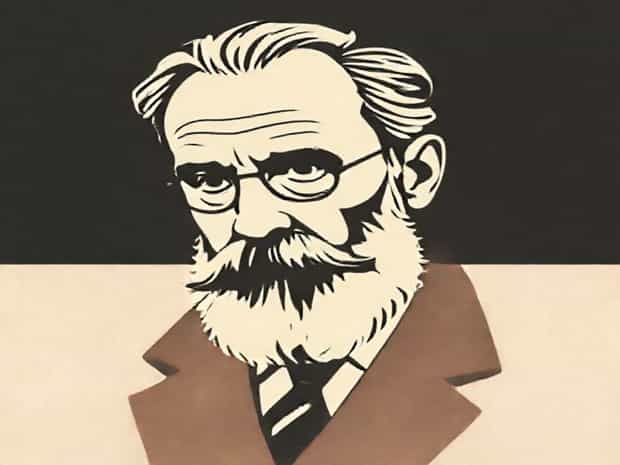
Facts About Werner Heisenberg
Werner Heisenberg was a German theoretical physicist whose groundbreaking work in quantum mechanics changed the course of modern physics. Born in 1901, Heisenberg demonstrated exceptional intellectual talent from a young age, quickly rising to prominence in the scientific community. He is best known for formulating the Uncertainty Principle, a concept that challenged classical notions of measurement and determinism. His work has had a lasting impact not only in physics but also in philosophy and the broader understanding of the natural world. Heisenberg’s career spanned turbulent historical periods, yet he remained deeply committed to advancing scientific knowledge.
Early Life and Education
Werner Heisenberg was born on December 5, 1901, in Würzburg, Germany. From his early years, he displayed a keen interest in mathematics and physics, subjects in which he excelled throughout his schooling. He pursued his higher education at the University of Munich, where he studied under some of the most prominent physicists of the time, including Arnold Sommerfeld. Heisenberg’s doctoral thesis focused on hydrodynamics, but his true passion soon shifted to the emerging field of quantum theory.
Contributions to Quantum Mechanics
Heisenberg made significant contributions to the development of quantum mechanics, an area of physics that deals with the behavior of ptopics at atomic and subatomic scales. One of his most famous achievements is the matrix formulation of quantum mechanics, which he developed in 1925. This formulation provided a new mathematical framework for understanding atomic behavior, differing greatly from the classical physics approaches that had dominated science for centuries.
The Uncertainty Principle
In 1927, Heisenberg introduced the Uncertainty Principle, a revolutionary idea stating that certain pairs of physical properties, like position and momentum, cannot be simultaneously measured with arbitrary precision. This principle fundamentally changed the way scientists think about observation and measurement in physics. Rather than providing exact outcomes, quantum mechanics allows for probabilities and uncertainties, reflecting the inherent limitations of measurement at the quantum level.
Nobel Prize and Recognition
Heisenberg’s groundbreaking work in quantum mechanics earned him widespread recognition. In 1932, he was awarded the Nobel Prize in Physics for the creation of quantum mechanics. His contributions not only advanced theoretical physics but also laid the foundation for many practical applications, including semiconductors, lasers, and quantum computing. Heisenberg’s achievements brought him international acclaim and solidified his place among the most influential physicists of the 20th century.
Work During World War II
During World War II, Heisenberg’s career became intertwined with the political climate of Germany. He was involved in nuclear research, leading efforts that some believe were intended to develop nuclear weapons. However, the exact nature of his work and intentions remain subjects of historical debate. Despite the controversy, Heisenberg continued to contribute to theoretical physics, publishing papers that further advanced the understanding of atomic structures and nuclear processes.
Post-War Contributions
After the war, Heisenberg played a critical role in rebuilding German science and academia. He became a leading figure in promoting physics education and research in post-war Germany. He helped establish new institutions and mentored a generation of physicists who would go on to make significant contributions themselves. His post-war work also included research in unified field theory and ptopic physics, demonstrating his continued commitment to advancing scientific knowledge.
Philosophical and Ethical Considerations
Heisenberg was not only a physicist but also a thinker deeply concerned with the philosophical implications of his work. The Uncertainty Principle, for example, raised profound questions about determinism, reality, and the limits of human knowledge. He wrote extensively on these topics, exploring how modern physics intersects with philosophy. His reflections emphasized that scientific discoveries often challenge existing worldviews and require careful ethical and philosophical consideration.
Legacy and Influence
Werner Heisenberg’s legacy extends far beyond his scientific achievements. His work fundamentally changed the way scientists understand the atomic and subatomic world. The Uncertainty Principle continues to influence both theoretical research and practical applications in physics. Heisenberg’s contributions to quantum mechanics laid the groundwork for technologies that are now integral to modern life, from electronics to medical imaging. Moreover, his thoughtful engagement with the philosophical dimensions of science continues to inspire scholars across disciplines.
Famous Quotes
- Not only is the universe stranger than we think, it is stranger than we can think.”
- “What we observe is not nature itself, but nature exposed to our method of questioning.”
- “The first gulp from the glass of natural sciences will turn you into an atheist, but at the bottom of the glass, God is waiting for you.”
Werner Heisenberg remains one of the towering figures of modern science. From his early work in quantum mechanics to the philosophical implications of the Uncertainty Principle, his contributions have left an indelible mark on physics and beyond. Despite the controversies surrounding his activities during World War II, his scientific legacy is undeniable. Heisenberg’s life demonstrates the power of human curiosity, intellectual rigor, and the enduring impact of ideas that challenge our understanding of the natural world. His work continues to inspire scientists, students, and thinkers to explore the unknown and embrace the complexities of the universe.