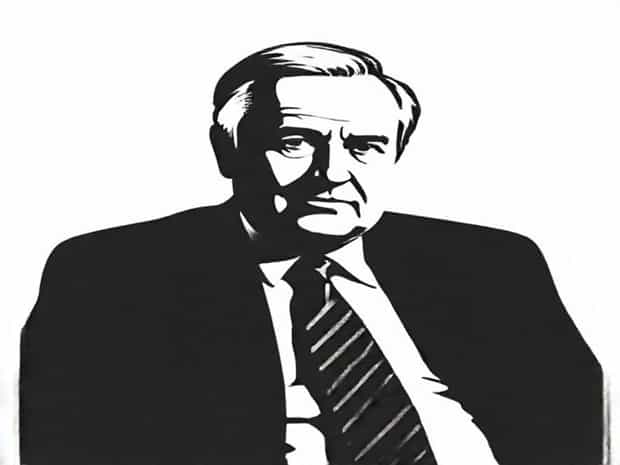
John Bruton ? Rip
John Bruton, former Taoiseach (Prime Minister) of Ireland, passed away on February 6, 2024, at the age of 76 after a prolonged illness. His death marked the end of a distinguished political career that spanned over three decades, during which he played a pivotal role in shaping modern Ireland. Bruton was widely recognized for his integrity, dedication to public service, and significant contributions to both domestic and international affairs.
Early Life and Political Beginnings
Born in May 1947 in Dunboyne, County Meath, John Bruton embarked on his political journey at the age of 22 when he was elected to the Dáil (Irish Parliament) in the 1969 general election. At that time, he became the fifth youngest TD ever elected. His early involvement in politics was marked by a commitment to public service and a deep understanding of the issues facing his constituents and the nation.
Leadership of Fine Gael
Bruton’s leadership of the Fine Gael party began in 1990 and continued until 2001. Under his guidance, the party navigated through challenging political landscapes, advocating for policies that balanced economic growth with social responsibility. His tenure was characterized by a steady hand and a focus on pragmatic solutions to Ireland’s pressing issues.
As Taoiseach 1994-1997
In December 1994, Bruton became Taoiseach, leading a coalition government known as the rainbow coalition,” which included Fine Gael, Labour, and Democratic Left. During his time in office, Bruton was instrumental in advancing Ireland’s economic development and social reforms. Notably, he championed the successful referendum in 1995 that legalized divorce in Ireland, a significant shift in the country’s social policy.
Contributions to the Northern Ireland Peace Process
One of Bruton’s most enduring legacies is his role in the Northern Ireland peace process. He worked tirelessly to foster dialogue between the Irish and British governments, as well as with various political factions in Northern Ireland. His efforts laid the groundwork for the Good Friday Agreement of 1998, which brought a significant reduction in sectarian violence and established a devolved government for Northern Ireland.
Economic and Social Reforms
During his tenure as Taoiseach, Bruton implemented policies that contributed to Ireland’s economic growth, often referred to as the “Celtic Tiger” period. He also focused on social reforms, including improvements in education and healthcare, aiming to create a more equitable society.
Post-Political Career
After retiring from domestic politics in 2004, Bruton continued to serve Ireland on the international stage. He was appointed as the European Union’s Ambassador to the United States, a position he held from 2004 to 2009. In this role, he worked to strengthen transatlantic relations and promote Ireland’s interests within the EU framework.
Personal Life and Legacy
John Bruton was remembered not only for his political achievements but also for his personal qualities. He was described as a man of integrity, compassion, and dedication to his family and country. His funeral Mass took place in the chapel of Saints Peter and Paul in Dunboyne, Co. Meath, where tributes highlighted his character and contributions to Irish society. Fr. Bruce Bradley SJ, who officiated the service, referred to him as “an exceptionally good man,” emphasizing the profound impact he had on those who knew him.
Tributes and Memorials
Following his passing, tributes poured in from across the political spectrum and beyond. Irish President Michael D. Higgins expressed deep sorrow, describing Bruton as a “man of hope, ideas, and faith” who changed Ireland and its people for the better. Former British Prime Minister Sir John Major also paid tribute, acknowledging Bruton’s significant role in fostering peace and cooperation between Ireland and the United Kingdom.
John Bruton’s death marks the end of an era in Irish politics. His leadership, vision, and commitment to public service left an indelible mark on the nation. As Ireland continues to evolve, the principles and policies championed by Bruton will remain a testament to his dedication to creating a better, more inclusive society. His legacy serves as an inspiration for future generations of leaders and citizens alike.