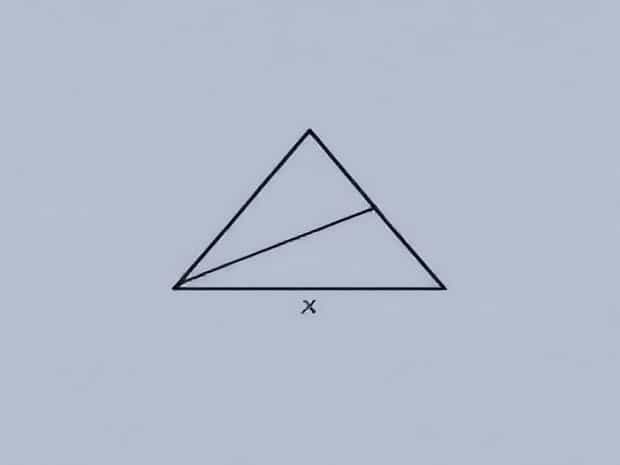
How To Solve For X In An Equilateral Triangle
When working with geometry problems, one of the most common shapes students encounter is the equilateral triangle. This unique triangle has three equal sides and three equal angles, each measuring 60 degrees. Because of its symmetry and balanced properties, many mathematical problems use equilateral triangles as the base for equations. Often, students are asked to solve for x in an equilateral triangle, whether it represents a side length, an angle, or a variable in a formula. Understanding the step-by-step process for solving these problems makes geometry much easier to handle and helps in exams where precision is important.
Understanding the Properties of an Equilateral Triangle
Before solving for x, it is important to review the basic characteristics of an equilateral triangle. These properties are essential because they provide the foundation for any algebraic or geometric calculation involving the triangle.
- All three sides are equal in length.
- All three interior angles are equal and measure exactly 60 degrees.
- The triangle is symmetrical, meaning it can be divided into two congruent halves with a line of symmetry.
- The height of the triangle can be found using the Pythagorean theorem when the side length is known.
Types of Problems Involving Solving for x
When you are asked to solve for x in an equilateral triangle, the variable may represent different values depending on the problem. Some common cases include
- x representing the side length of the triangle.
- x representing part of an angle measure or equation involving angles.
- x representing the height of the equilateral triangle.
- x as part of a perimeter or area formula.
Each type of problem requires a slightly different approach, but all rely on the properties of equilateral triangles.
Solving for x When It Represents the Side Length
One of the simplest cases is when x represents the side length. If a problem states that each side of the equilateral triangle is expressed in terms of x, such as each side is 2x + 3, you may need to use additional information to solve for x. For example, if the perimeter of the triangle is given, you can set up an equation.
ExampleEach side of an equilateral triangle is 2x + 3, and the perimeter is 30. Solve for x.
Step 1 Write the formula for perimeter.
Perimeter = 3 Ã side length.
Step 2 Substitute the given values.
30 = 3 Ã (2x + 3)
Step 3 Simplify.
30 = 6x + 9
Step 4 Solve for x.
6x = 21 â x = 3.5
Solving for x in Angle Problems
Sometimes, equations involving x appear in the angle measures of a triangle. Since all angles in an equilateral triangle are 60 degrees, you can set up an equation to solve for x.
ExampleIn an equilateral triangle, one angle is given as (2x + 10) degrees. Solve for x.
Step 1 Recall that each angle = 60 degrees.
2x + 10 = 60
Step 2 Subtract 10 from both sides.
2x = 50
Step 3 Divide by 2.
x = 25
Solving for x in Height Problems
The height of an equilateral triangle divides it into two right-angled triangles. This is useful when x appears in relation to height. By applying the Pythagorean theorem, you can solve for x.
ExampleAn equilateral triangle has a side length of x. Find x if the height is given as 6 cm.
Step 1 Split the triangle in half. The base becomes x/2, the height is 6, and the hypotenuse is x.
Step 2 Apply Pythagoras’ theorem (height)² + (base)² = (side)².
6² + (x/2)² = x²
36 + x²/4 = x²
Step 3 Multiply through by 4 to remove fractions.
144 + x² = 4x²
Step 4 Rearrange.
3x² = 144 â x² = 48 â x = â48
Step 5 Simplify.
x â 6.93 cm
Using Perimeter to Solve for x
Perimeter problems often involve variables in side lengths. If each side is written in terms of x, you can solve equations quickly using the perimeter formula.
ExampleIf each side of an equilateral triangle is (x + 2) cm, and the perimeter is 24 cm, find x.
Step 1 Formula â Perimeter = 3 Ã side.
24 = 3(x + 2)
Step 2 Simplify.
24 = 3x + 6
Step 3 Solve for x.
3x = 18 â x = 6
Using Area to Solve for x
The formula for the area of an equilateral triangle is
Area = (â3 / 4) à side²
If the area is known, and the side length involves x, you can substitute values to solve for x.
ExampleThe area of an equilateral triangle is 16â3 cm². Each side is x cm. Find x.
Step 1 Write the formula.
16â3 = (â3 / 4) à x²
Step 2 Multiply both sides by 4.
64â3 = â3 à x²
Step 3 Divide both sides by â3.
64 = x²
Step 4 Solve for x.
x = 8
Common Mistakes When Solving for x
While solving for x in equilateral triangle problems, students sometimes make errors that lead to incorrect results. Here are a few common mistakes to avoid
- Forgetting that all angles must equal 60 degrees.
- Using incorrect perimeter or area formulas.
- Not dividing the base properly when calculating height with the Pythagorean theorem.
- Leaving answers unsimplified when radicals are involved.
Practical Applications of Solving for x
Learning how to solve for x in equilateral triangles is not only useful in exams but also applies to real-world contexts. Architects, engineers, and designers often use equilateral triangles in construction, art, and structural design because of their stability and symmetry. Understanding these concepts ensures accuracy in professional fields as well.
Equilateral triangles are simple yet powerful in geometry, and problems often require solving for x in terms of sides, angles, perimeter, or area. By remembering that all sides and angles are equal, applying algebraic methods, and using formulas like Pythagoras’ theorem and the area equation, solving these problems becomes straightforward. Whether you are preparing for exams or simply strengthening your understanding of geometry, mastering how to solve for x in an equilateral triangle will help build a strong mathematical foundation that is useful both in academics and in practical life.