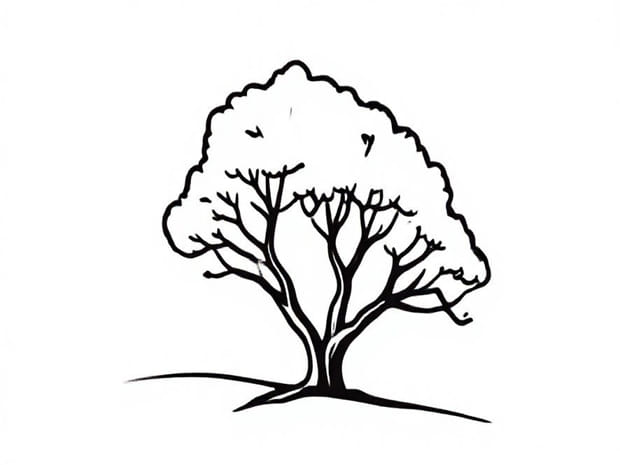
How To Draw A Treeline
Drawing a treeline is a rewarding artistic skill that can enhance landscapes and provide depth to illustrations. A treeline represents the edge of a forest or a grouping of trees along a horizon, often adding context and atmosphere to natural scenes. Learning how to draw a treeline involves understanding perspective, tree shapes, textures, and layering techniques. This type of drawing can range from simple silhouettes to detailed renderings that capture individual branches, leaves, and light effects. By mastering the steps of sketching, adding details, and refining the composition, artists can create realistic and visually engaging treelines that enrich their artwork and bring outdoor scenes to life.
Understanding the Basics of a Treeline
Before beginning your drawing, it’s important to understand what a treeline represents in nature. A treeline is typically seen from a distance, so the shapes of the trees often appear as overlapping forms rather than distinct, detailed objects. Trees vary in height, width, and shape, and these variations create a natural rhythm in a landscape. Observing real-life treelines or photographs can help you understand how trees interact with each other and with the surrounding environment. Pay attention to the density, spacing, and types of trees as these factors influence the composition of your drawing.
Choosing the Right Perspective
Perspective plays a key role in drawing a convincing treeline. Decide whether your view will be from the ground, looking up, or from a distance, looking across a landscape. A distant view often simplifies tree shapes into silhouettes, while a closer perspective allows for more detailed textures and individual branches. Consider the horizon line and how the treeline aligns with it, as this affects the sense of depth and scale. Using light guidelines can help you maintain a consistent perspective throughout your drawing.
Sketching the Basic Shapes
Begin by sketching the general outline of the treeline. Use simple shapes such as triangles, ovals, and irregular blobs to represent tree forms. Focus on the overall contour and the variation in heights to avoid uniformity. Trees in nature are rarely identical, so introducing slight differences in shape and size creates a more realistic and dynamic composition. Light, loose lines at this stage make it easier to adjust the shapes as you refine the drawing.
Layering the Trees
Layering is an important technique when drawing a treeline. Trees closer to the foreground are often larger and more detailed, while those in the background appear smaller and less defined. Use overlapping shapes to create depth, making sure that the edges of trees vary to suggest a natural, irregular forest edge. This layering effect helps the viewer perceive distance and adds richness to the landscape. Varying the density of the trees also enhances realism, as natural forests have gaps and clusters rather than a rigid, linear edge.
Adding Details to the Trees
Once the basic shapes are in place, begin adding details to individual trees. For closer trees, include trunks, branches, and leaf clusters. Use a combination of lines and shading to indicate texture and volume. Avoid drawing every leaf individually; instead, suggest foliage through clusters and patterns that capture the general shape and density. Adding subtle variations in the size and direction of branches and leaves gives your treeline a more organic appearance.
Texture and Patterns
Texture is essential for creating a realistic treeline. Different types of trees have unique bark patterns and foliage textures. Use short, repeated strokes to suggest leaves, and vary line weight to convey depth and shadow. For coniferous trees, you might use triangular strokes to indicate needle clusters, while broadleaf trees can be represented with rounded, overlapping shapes. Experimenting with different textures allows you to depict a diverse and visually interesting treeline.
Shading and Depth
Shading enhances the three-dimensional quality of your treeline. Identify a light source and apply shadows accordingly, adding darker tones to areas where trees overlap or recede into the background. Gradual shading on the trunks and foliage can suggest volume and form. For trees in the distance, reduce the contrast and simplify the shapes to create the illusion of atmospheric perspective. This technique helps the treeline blend naturally into the landscape and emphasizes the sense of depth.
Foreground and Background Integration
Integrating the treeline with foreground and background elements creates a cohesive composition. Consider adding hills, meadows, or water bodies in the foreground to enhance the sense of space. Background elements such as mountains, skies, or distant hills can complement the treeline and give context to the scene. Using softer lines and lighter tones for distant objects ensures that the treeline remains the focal point while maintaining natural perspective.
Refining and Finalizing the Drawing
After adding details, textures, and shading, refine your drawing by cleaning up guidelines and emphasizing key elements. Adjust the edges of trees, enhance contrast where necessary, and add small touches like branches, leaves, or subtle highlights to bring the treeline to life. Step back and evaluate the overall composition to ensure balance, variation, and a natural flow. Making small adjustments can significantly improve the realism and visual impact of your artwork.
Tips for Drawing a Treeline
- Observe real treelines to understand natural variation in height, shape, and spacing.
- Use light sketch lines to outline the basic forms before adding details.
- Layer trees to create depth, using larger and more detailed forms in the foreground.
- Vary textures for different tree types to add visual interest.
- Apply shading gradually to convey volume and light direction.
- Integrate the treeline with background and foreground elements for a complete composition.
- Keep edges irregular and varied to mimic natural tree patterns.
- Use atmospheric perspective to enhance depth and realism.
- Practice regularly to develop speed, confidence, and style.
Drawing a treeline is both an artistic and observational skill that enhances landscape illustrations and provides depth to natural scenes. By understanding the basic shapes, layering trees, adding details and textures, applying shading, and integrating the treeline with surrounding elements, artists can create realistic and visually engaging depictions of forest edges. With practice, attention to detail, and experimentation with different perspectives and textures, drawing a treeline becomes a rewarding process that adds richness and atmosphere to your artwork, capturing the beauty and complexity of natural landscapes.