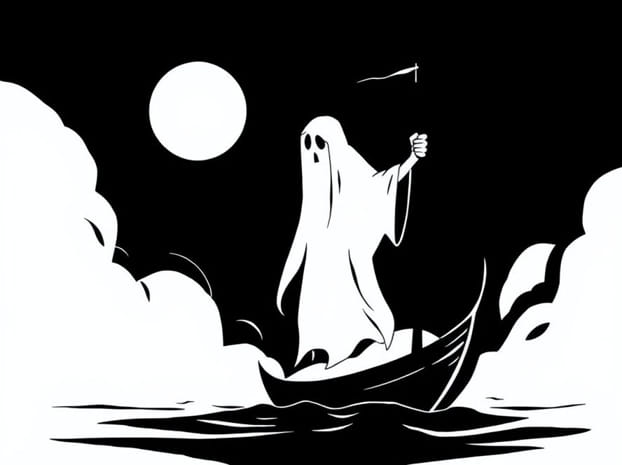
Ghost Charon The Underworld Boatman
In the vast tapestry of Greek mythology, few figures capture the imagination quite like Charon, the ghostly ferryman of the underworld. Known for guiding souls across the River Styx or Acheron, Charon is a mysterious figure often depicted as both feared and respected. His role as the boatman of the dead has transcended ancient myths, influencing literature, art, and even modern culture. To understand the symbolism of Charon is to explore themes of mortality, passage, and the unknown realms of the afterlife. The image of the spectral boatman patiently waiting for payment with a coin in hand continues to resonate with people across generations.
The Origins of Charon
Charon’s story originates from ancient Greek mythology, where he was believed to be the son of Nyx (the goddess of night) and Erebus (the personification of darkness). This lineage alone gave him a spectral and shadowy nature, fitting his role as the ghostly guide to the underworld. His name itself, Charon, is often associated with fierce brightness or burning gaze, though his image is typically depicted as grim and stern.
Charon was not seen as a deity of glory but as a necessary figure in the cycle of life and death. His existence symbolizes the inevitability of mortality, showing that even kings and heroes must pay their fare to cross into the realm of Hades. This concept has become one of the most enduring parts of classical mythology.
The River Crossing
The central role of Charon lies in transporting the souls of the deceased across the rivers of the underworld, most often the Styx or the Acheron. These waters were not just geographical boundaries but spiritual barriers between the living world and the land of the dead. Without Charon’s assistance, souls would be left to wander endlessly on the near shore, unable to find peace.
For this reason, ancient Greeks often placed a coin, known as an obolus, in the mouth or over the eyes of the dead. This payment ensured that Charon would accept them onto his boat. Those without proper burial rites or coin offerings were said to remain restless, trapped without passage. The ritual highlights how deeply intertwined Charon’s myth was with funeral practices and the fear of an incomplete journey into the afterlife.
Depictions in Art and Literature
Charon the underworld boatman has been depicted in various ways throughout history. Ancient vase paintings often portray him as an older man with a long beard, holding an oar or pole. His appearance is not terrifying but stern, fitting his duty as the impartial ferryman.
In literature, Charon appears in the works of classical poets such as Virgil in the Aeneid and later in Dante’s Divine Comedy. Virgil describes Charon as a frightening figure with fiery eyes, emphasizing the dread of crossing into the land of the dead. Dante’s version portrays him as a more terrifying presence, adding to the chilling atmosphere of the Inferno. These literary portrayals ensured Charon’s legacy as one of the most haunting figures of the afterlife.
Symbolism of the Ferryman
Charon represents more than just a guide. His ghostly presence embodies the threshold between life and death, a liminal figure standing at the boundary of existence. He is impartial, treating all souls the same regardless of their deeds in life. This neutrality makes him a symbol of inevitability and equality in death.
His demand for a coin emphasizes the importance of ritual, preparation, and respect for tradition. The symbolic payment is not about wealth but about acknowledging the passage and showing readiness for the journey. The ferry ride with Charon has thus become a metaphor for transition, whether in death, spiritual transformation, or personal change.
Charon in Popular Culture
Beyond classical mythology, Charon has made his way into modern culture. He is referenced in literature, video games, films, and even music. His image as the silent, ghostly boatman resonates with audiences because it encapsulates both fear and fascination with the afterlife.
For instance, in fantasy role-playing games, Charon often appears as a character or symbol connected to death and the supernatural. In films and television, his image is sometimes reimagined as a darker figure, cloaked and hooded, representing the inevitability of death’s call. These adaptations keep the myth alive while allowing for creative reinterpretations of his story.
The Psychological Impact of the Myth
Charon’s story has psychological depth, reflecting humanity’s age-old struggle with mortality. The ghostly boatman represents the unknown aspects of death that people fear yet cannot escape. By placing such a figure at the crossing, the myth provides structure and meaning to an otherwise incomprehensible journey.
The concept of payment can also be interpreted as symbolic accountability. The coin given to Charon suggests that every soul must contribute something to pass on, reminding the living of their responsibility to prepare for the afterlife, whether spiritually, morally, or ritually.
Religious and Cultural Parallels
The myth of Charon the underworld boatman is not unique to Greek mythology. Many cultures around the world have their own figures who help souls transition from life to death. For example, in ancient Egyptian belief, the god Anubis guided souls to judgment. In Norse mythology, the goddess Hel ruled over the underworld. The presence of such guides across different traditions shows how universal the fear and acceptance of death has always been.
Charon’s enduring figure highlights the human need to believe that death is not an end but a passage. The ferryman ensures that even in death, there is movement, continuity, and order rather than chaos.
Charon’s Lasting Legacy
Though thousands of years have passed since the myths were first told, the ghostly figure of Charon still holds relevance. His image is timeless because it connects with the most universal human experience death. By embodying the mystery of crossing into another world, he gives a face to the unknown and a ritual to the inevitable.
From ancient coins buried with the dead to modern references in games and movies, Charon remains one of the most iconic symbols of the underworld. His stern duty as boatman reminds us that all journeys must end, but also that every ending is a passage into something beyond.
Key Takeaways
- Charon is the ghostly ferryman of the underworld in Greek mythology.
- He transports souls across the River Styx or Acheron in exchange for a coin.
- Charon symbolizes transition, mortality, and impartiality in death.
- He has been featured in classical art, literature, and modern popular culture.
- His myth reflects universal human concerns about death and the afterlife.
Charon the underworld boatman continues to haunt the imagination because he represents both fear and hope. He is a reminder that death is not simply an end but a crossing, a journey into realms we cannot yet know. His ghostly presence ensures that the myth will endure for generations, echoing across cultures as a symbol of life’s ultimate passage.