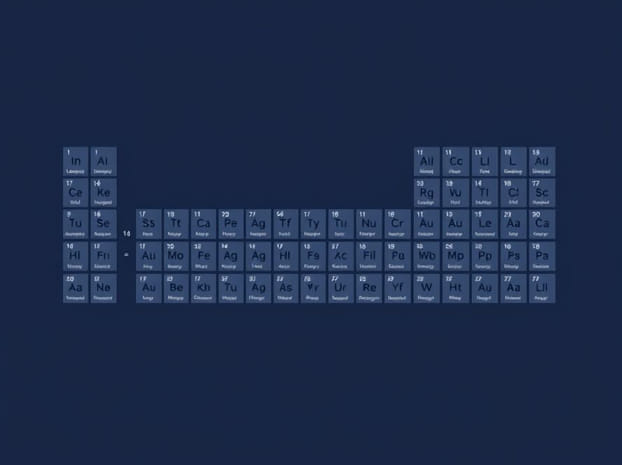
Elements In Mendeleev Periodic Table
When Dmitri Mendeleev introduced his periodic table in 1869, it marked one of the most important milestones in the history of chemistry. By arranging elements according to their atomic mass and chemical properties, Mendeleev provided a framework that not only explained existing knowledge but also predicted the existence of elements yet to be discovered. His table was revolutionary because it highlighted periodic trends and left gaps for elements that were unknown at the time, showing confidence in the logical arrangement of matter. To understand the significance of Mendeleev’s contribution, it is essential to look closely at the elements in his periodic table, how they were arranged, and why this work continues to influence modern chemistry today.
Structure of Mendeleev’s Periodic Table
Mendeleev’s periodic table was different from the modern table we see today. Instead of organizing elements strictly by atomic number, which was not known at the time, he arranged them in order of increasing atomic mass. This allowed him to group elements with similar chemical behaviors together, creating vertical columns known as groups.
Key Features of His Arrangement
- Elements were arranged in rows called periods, according to atomic mass.
- Vertical groups contained elements with similar valence properties.
- He left intentional gaps where he believed undiscovered elements should fit.
- Certain elements were placed out of strict atomic mass order to preserve chemical similarity.
For example, iodine was placed after tellurium despite having a lower atomic mass because iodine’s chemical behavior matched better with chlorine and bromine.
Examples of Elements in Mendeleev’s Table
The table contained 63 known elements at the time. Here are some examples of how he classified them
- Group I (alkali metals)Lithium, sodium, potassium, rubidium, and cesium were grouped together due to their reactive properties and tendency to form +1 ions.
- Group VII (halogens)Fluorine, chlorine, bromine, and iodine were recognized as forming -1 ions and showing strong reactivity with metals.
- Transition metalsIron, copper, silver, and gold were grouped based on similarities in conductivity and ability to form colored compounds.
- ChalcogensOxygen, sulfur, selenium, and tellurium were placed together because of their tendency to form oxides and sulfides.
Predictions and Missing Elements
One of Mendeleev’s most brilliant moves was leaving empty spaces in his periodic table for elements that were unknown at the time. He made detailed predictions about their properties, including atomic mass, density, and chemical behavior. These gaps demonstrated the predictive power of the periodic table.
Notable Predictions
- Gallium (eka-aluminum)Predicted by Mendeleev and discovered in 1875, its properties matched his forecasts almost exactly.
- Scandium (eka-boron)Discovered in 1879, its characteristics confirmed Mendeleev’s predictions.
- Germanium (eka-silicon)Found in 1886, its behavior aligned with the properties Mendeleev had outlined.
These successful predictions elevated the credibility of his periodic law and established the table as a scientific tool rather than just a classification chart.
Comparison with the Modern Periodic Table
While Mendeleev’s arrangement was groundbreaking, it has since been refined into the modern periodic table, which is based on atomic number instead of atomic mass. Henry Moseley’s discovery in 1913 clarified that atomic number was the true basis for periodicity. This corrected inconsistencies like the placement of tellurium and iodine.
Differences Between Mendeleev’s Table and the Modern Version
- Mendeleev arranged by atomic mass, while the modern table uses atomic number.
- His table had gaps for undiscovered elements, while the modern table is mostly complete.
- Mendeleev’s table did not include noble gases, as they were discovered later in the 1890s.
- The modern table includes lanthanides and actinides, which were unknown in Mendeleev’s time.
Impact on Chemistry
The elements in Mendeleev’s periodic table provided a systematic way to study chemistry. Before his table, elements were catalogued without clear organization. By grouping them logically, Mendeleev allowed scientists to predict chemical behavior and discover new elements more efficiently. His periodic law showed that the properties of elements are periodic functions of their atomic masses, paving the way for the modern periodic law based on atomic numbers.
Examples of Trends Identified by Mendeleev
Even without today’s understanding of electron configurations, Mendeleev recognized patterns in the elements he arranged
- ReactivityAlkali metals became more reactive as you moved down the group.
- ValencyElements in the same column tended to form similar types of compounds.
- Atomic mass periodicityRepeated trends in physical and chemical properties appeared at regular intervals.
These trends remain valid today and form the foundation for chemical education worldwide.
The Absence of Noble Gases
One notable difference between Mendeleev’s periodic table and the modern one is the absence of noble gases. Elements such as helium, neon, argon, krypton, xenon, and radon were not discovered until after 1894. Once these were identified, they were added as a new group, completing the table and enhancing its predictive structure.
Challenges Mendeleev Faced
Mendeleev’s arrangement was not universally accepted at first. Some chemists were skeptical of leaving gaps for elements that had not yet been discovered. Additionally, a few atomic masses were not accurately measured at the time, which created inconsistencies. However, as new elements were discovered and his predictions proved correct, his system gained recognition.
Educational Value of Mendeleev’s Table
Today, the study of Mendeleev’s periodic table is not just about history but also about understanding the scientific process. His work shows how observation, prediction, and logical reasoning can lead to groundbreaking discoveries. Students learn how scientific models evolve over time, adapting to new evidence and discoveries.
Modern Relevance of Mendeleev’s Work
Even though the modern periodic table has evolved, the core idea of arranging elements to highlight recurring properties remains Mendeleev’s legacy. His periodic law continues to inspire new research in materials science, quantum chemistry, and nanotechnology. By starting with the elements in Mendeleev’s periodic table, chemists gained a roadmap that expanded into one of the most powerful tools in science.
The elements in Mendeleev’s periodic table were more than just a list of chemical substances; they represented a new way of thinking about matter and its organization. By arranging them according to atomic mass and chemical similarity, Mendeleev not only brought order to chemistry but also predicted the existence of new elements with remarkable accuracy. Though the modern table now uses atomic number, the foundation laid by Mendeleev remains a cornerstone of science. His work demonstrates how systematic reasoning can lead to discovery, making the periodic table one of the greatest achievements in scientific history.