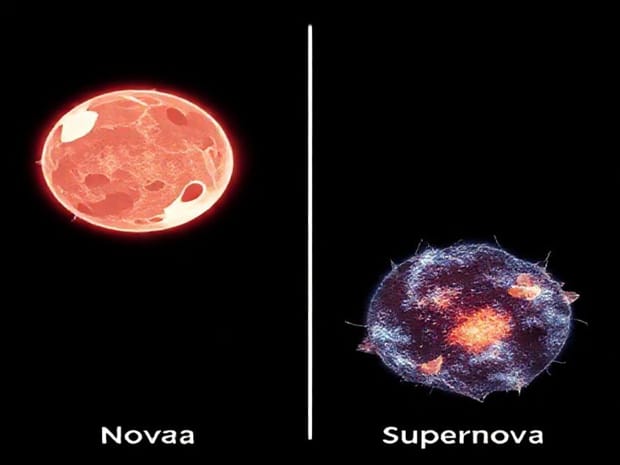
Difference Between Nova And Supernova
The universe is full of extraordinary events that capture human imagination, and among the most fascinating are stellar explosions known as novae and supernovae. Both terms are often used interchangeably by those unfamiliar with astronomy, but they describe very different cosmic phenomena. While a nova involves a temporary brightening of a star caused by nuclear reactions on its surface, a supernova is a much more powerful explosion signaling either the death of a massive star or the collapse of a white dwarf. To fully appreciate the difference between nova and supernova, one must explore their causes, characteristics, and their lasting impact on the cosmos.
Understanding the Concept of Nova
A nova occurs in a binary star system where one of the stars is a white dwarf. A white dwarf is the remnant core of a star that has already exhausted its nuclear fuel. When paired with a companion star, usually a main-sequence or red giant, the white dwarf can gravitationally pull hydrogen-rich material from its partner. This accumulation of matter eventually triggers a thermonuclear reaction on the white dwarf’s surface, producing a sudden brightening visible from Earth.
Key Features of a Nova
- A nova can brighten by several magnitudes, sometimes making an otherwise faint star visible to the naked eye.
- The explosion does not destroy the white dwarf; the process can repeat multiple times as more material is accreted.
- Novae are relatively frequent compared to supernovae, with dozens observed in our galaxy each century.
- The brightness usually fades within weeks or months, returning the star system to its normal appearance.
Types of Novae
There are classical novae, which occur due to surface thermonuclear reactions, and recurrent novae, which repeat over decades or centuries. In recurrent systems, the same white dwarf experiences multiple nova events due to repeated accumulation of material from its companion.
Understanding the Concept of Supernova
A supernova is a far more dramatic event than a nova. It represents the destruction or radical transformation of a star, releasing an enormous amount of energy and often leaving behind exotic objects like neutron stars or black holes. Unlike novae, supernovae are rare in our galaxy, occurring only a few times per century, but their brightness can briefly outshine an entire galaxy.
Types of Supernovae
Supernovae are classified into two major types based on their origin
- Type I SupernovaThis occurs when a white dwarf in a binary system accumulates so much material that it exceeds the Chandrasekhar limit (about 1.4 times the mass of the Sun). The star can no longer support itself and collapses, resulting in a runaway thermonuclear explosion.
- Type II SupernovaThis type occurs in massive stars that are at least eight times the mass of the Sun. When their nuclear fuel is exhausted, their cores collapse under gravity, creating a catastrophic explosion that disperses most of the star’s material into space.
Key Features of a Supernova
- A supernova can release more energy in a few seconds than the Sun will emit over its entire lifetime.
- Supernovae are responsible for creating many of the heavy elements in the universe, including iron and gold.
- The explosion often leaves behind remnants like pulsars, neutron stars, or black holes.
- Some supernovae are visible even in daylight, such as the famous SN 1054 observed by Chinese astronomers.
Difference Between Nova and Supernova
Although both involve sudden brightening of stars, the differences between nova and supernova are profound. These differences can be broken down into several categories
Scale of Energy Release
A nova is relatively small in scale, brightening a star temporarily without destroying it. In contrast, a supernova is an immensely powerful event capable of altering galaxies and enriching the cosmos with elements.
Impact on the Star
- NovaThe white dwarf survives and can experience multiple nova events.
- SupernovaThe star is either completely destroyed or transformed into a dense remnant.
Frequency of Occurrence
Novae occur more frequently, with many detected each century in the Milky Way. Supernovae are rarer, with only a few visible in the same time span, but their impact is far more significant.
Brightness and Visibility
Novas brighten enough to be seen with telescopes and sometimes with the naked eye, but supernovae can outshine entire galaxies for weeks, making them visible across vast distances in the universe.
Scientific Importance of Novae
While novae may seem less dramatic, they are scientifically valuable. They allow astronomers to study binary systems, accretion processes, and nuclear reactions on stellar surfaces. Observations of novae also contribute to understanding stellar evolution and the behavior of white dwarfs.
Scientific Importance of Supernovae
Supernovae play a crucial role in the cosmic ecosystem. By dispersing heavy elements into space, they provide the building blocks for new stars, planets, and even life itself. The shockwaves from supernovae can trigger star formation in nearby molecular clouds, driving the cycle of stellar birth and death. Furthermore, supernovae are essential tools for measuring cosmic distances, particularly Type Ia supernovae, which act as standard candles” in astronomy.
Historical Observations
Throughout history, both novae and supernovae have been observed and recorded. For example, the famous supernova of 1604, also known as Kepler’s Supernova, was visible to the naked eye and studied extensively. Novae, while less spectacular, have also been documented regularly by astronomers, with records dating back centuries.
Modern Observations and Technology
Today, advanced telescopes and space observatories allow astronomers to study novae and supernovae in unprecedented detail. High-resolution imaging and spectroscopy provide insights into the composition of ejected material, the processes driving the explosions, and their contribution to the universe’s chemical enrichment.
Key Takeaways
- A nova is a surface-level thermonuclear reaction on a white dwarf that temporarily increases its brightness.
- A supernova is a catastrophic stellar explosion that can destroy or transform a star entirely.
- Novae are relatively common, while supernovae are rare but much more powerful.
- Both play vital roles in our understanding of stars, galaxies, and the evolution of the universe.
Recognizing the difference between nova and supernova deepens our appreciation for the complexity of the cosmos. Novae remind us of the ongoing interactions within binary systems, while supernovae demonstrate the dramatic final stages of stellar evolution and their role in shaping the universe. Together, these stellar phenomena highlight the beauty and power of the stars, reminding us that the night sky is not static but a stage for extraordinary cosmic events that continue to unfold over time.