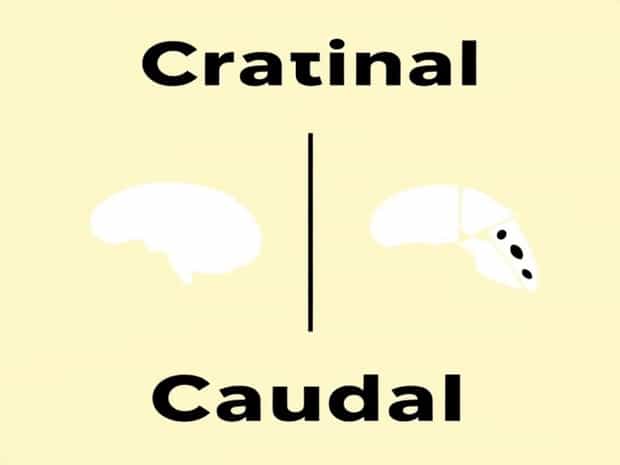
Difference Between Cranial And Caudal
The terms cranial” and “caudal” are commonly used in anatomy and biology to describe positions and directions within the body. Understanding these terms is essential for students, medical professionals, and anyone studying anatomy because they provide a clear and standardized way to describe locations relative to the body. While both terms are directional, they refer to opposite ends of the body, and confusing them can lead to misunderstandings in medical contexts, animal anatomy, and surgical procedures. A thorough understanding of cranial and caudal terminology helps in accurate communication and comprehension of anatomical structures.
Definition of Cranial
Cranial refers to a position that is closer to the head or the upper part of the body. The term is derived from “cranium,” which is the part of the skull that encloses the brain. In humans, cranial is often used interchangeably with “superior,” especially when describing structures relative to the rest of the body. For example, the chest is cranial to the abdomen because it is located closer to the head. In veterinary medicine, cranial indicates proximity to the animal’s head along the longitudinal axis of the body.
Examples of Cranial Position
- The eyes are cranial to the mouth.
- The shoulders are cranial to the hips.
- The forehead is cranial to the chin.
Definition of Caudal
Caudal, in contrast, refers to a position that is closer to the tail or the lower end of the body. The term originates from “cauda,” which means tail in Latin. In human anatomy, caudal is often synonymous with “inferior,” describing structures that are lower in position relative to other parts of the body. For example, the stomach is caudal to the chest because it is located toward the lower part of the body. In animals, caudal specifically refers to structures that are closer to the tail along the longitudinal axis.
Examples of Caudal Position
- The knees are caudal to the hips.
- The tailbone is caudal to the waist.
- The calves are caudal to the thighs.
Cranial vs Caudal in Humans
In humans, cranial and caudal are directional terms that describe the vertical orientation of body parts. These terms are crucial in anatomy, medicine, and imaging studies like MRI or CT scans. Cranial indicates structures closer to the head, while caudal points to areas closer to the feet. For example, when a doctor examines a spinal injury, they might note that the injury is cranial to the lower vertebrae or caudal to the upper vertebrae, providing precise localization within the body.
Medical Applications
- Describing tumor locations in the body.
- Specifying levels of spinal cord injuries.
- Guiding surgical procedures and imaging studies.
Cranial vs Caudal in Animals
In veterinary anatomy, cranial and caudal are used more extensively due to the horizontal orientation of most animals’ bodies. Cranial indicates structures toward the head, while caudal refers to structures closer to the tail. For quadrupeds, these terms help describe limb placement, organ position, and movement direction. For instance, the front legs of a dog are cranial to its hind legs, and the tail is caudal to the body. Using these terms helps veterinarians and animal scientists communicate precisely about anatomy and health conditions.
Examples in Animal Anatomy
- The shoulders of a horse are cranial to its hips.
- The kidneys of a cow are caudal to its lungs.
- The tail fin of a fish is caudal to its head fin.
Comparison of Cranial and Caudal
While both cranial and caudal describe positions along the longitudinal axis of the body, they represent opposite directions. Cranial always points toward the head, while caudal points toward the tail or lower end. Understanding this opposition is critical for anatomy students, medical professionals, and veterinary practitioners. These terms provide a standardized language for describing the relative positions of organs, bones, and tissues, preventing miscommunication in clinical, academic, and research settings.
Key Differences
- DirectionCranial is toward the head, caudal is toward the tail or lower end.
- Human UseCranial = superior, caudal = inferior.
- Animal UseCranial = toward head, caudal = toward tail.
- Clinical ImportanceHelps in precise localization of injuries, diseases, or surgical sites.
Common Mistakes and Clarifications
Many students and professionals confuse cranial and caudal, especially when switching between human and animal anatomy. In humans, the vertical body orientation makes cranial synonymous with superior and caudal with inferior. In animals, the horizontal orientation can create confusion with front (anterior) and back (posterior) terms. Being aware of these nuances ensures accurate communication and prevents mistakes in medical or scientific contexts.
Tips for Remembering
- Cranial = Cranium = Head.
- Caudal = Cauda = Tail.
- Think of cranial as moving upward toward the head and caudal as moving downward toward the lower body or tail.
- Use diagrams of both human and animal bodies to visualize these directions.
Understanding the difference between cranial and caudal is fundamental in anatomy, medicine, and veterinary sciences. Cranial refers to structures closer to the head, while caudal indicates positions closer to the tail or lower body. These directional terms provide a standardized way to describe anatomical locations, ensuring clear communication among students, healthcare professionals, and researchers. By mastering cranial and caudal, along with other directional terms, one can achieve precise understanding and description of anatomical structures across species.