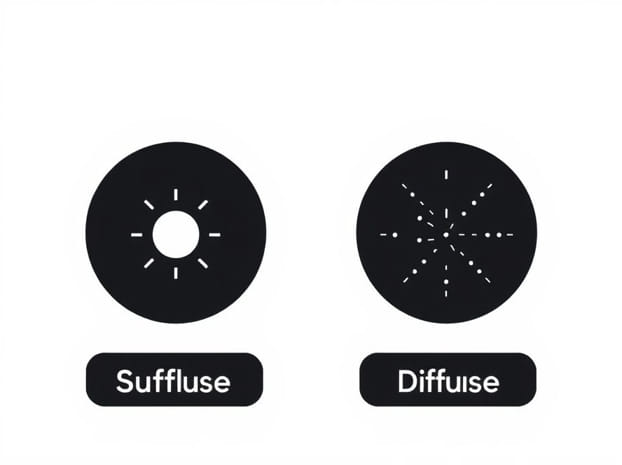
Define Suffuse Vs Diffuse
The words suffuse and diffuse may appear similar at first glance, and many people often confuse them in both writing and speech. However, their meanings and applications are not identical. Both terms describe a process of spreading, but they carry distinct connotations and are used in different contexts. Understanding the difference between suffuse vs diffuse is important for clear communication, whether you are writing literature, explaining science, or simply choosing the right word in everyday conversation. Exploring their definitions, examples, and nuances will help highlight the correct situations in which to use each term.
Defining Suffuse
To suffuse means to spread through or over something, usually in a way that saturates or fills it with a particular quality, feeling, or substance. The word often carries a poetic or figurative sense, making it common in literature and descriptions of emotions or appearances. Rather than describing a physical scattering, suffuse emphasizes the idea of being permeated or infused with a quality that transforms the subject.
Examples of Suffuse in Sentences
- Her face was suffused with joy when she received the good news.
- The room was suffused with the warm glow of candlelight.
- A sense of calm suffused the atmosphere after the storm passed.
In these examples, the word highlights how an emotion, light, or atmosphere spreads and fills a person or space, giving it a new character or quality.
Defining Diffuse
To diffuse means to spread out over a wide area, scatter in different directions, or distribute broadly. Unlike suffuse, it often implies a more physical or scientific process, such as the diffusion of gases, light, or information. It is less about emotional or figurative saturation and more about dispersal across a space. Diffuse can be used as both a verb and an adjective, making it versatile in technical and everyday contexts.
Examples of Diffuse in Sentences
- The fragrance of flowers diffused through the open window.
- In physics, heat diffuses from warmer areas to cooler areas.
- Her explanation was so diffuse that the audience lost interest.
These examples illustrate how the term is connected to spreading, scattering, or being widely distributed, whether physically or metaphorically.
Key Differences Between Suffuse and Diffuse
Although both words deal with spreading, their differences become clear when looking at their emphasis and tone.
- Suffusesuggests filling or saturating with a quality, often emotional, sensory, or figurative.
- Diffusesuggests dispersing or scattering broadly, often with a focus on physical or measurable processes.
- Suffuse is more common in literature, poetry, and descriptive writing, while diffuse is frequently used in science, technology, and analytical writing.
Origins and Etymology
Understanding the origins of each word adds depth to their distinction. Both words come from Latin roots, but their specific developments differ. Suffuse derives from the Latinsuffundere, meaning to pour beneath or to overspread. This origin reflects the sense of something flowing through or over, saturating the subject. Diffuse comes from the Latindiffundere, meaning to spread out or pour in different directions. This explains its association with scattering, dispersing, and broad distribution.
Practical Tips for Usage
To avoid mixing up the two words, consider these guidelines
- Usesuffusewhen describing a strong quality or feeling that fills something, like light, emotion, or color.
- Usediffusewhen referring to physical spreading, scattering, or lack of focus, such as gases, light, sound, or ideas.
- If the spreading is poetic and emotional, choose suffuse. If it is scientific, technical, or analytical, diffuse is the better choice.
Common Misuses and Confusions
Writers sometimes use diffuse when they mean suffuse because both words suggest spreading. For example, saying Her cheeks diffused with color is incorrect; the proper choice would be Her cheeks were suffused with color. Similarly, saying The gas suffused across the room is awkward; the correct phrasing is The gas diffused across the room. Keeping in mind the context emotional saturation versus physical dispersal helps avoid mistakes.
Adjective Form of Diffuse
Unlike suffuse, which is primarily used as a verb, diffuse also has a common adjective form. As an adjective, it means spread out, not concentrated, or lacking clarity. For example
- The sunlight was diffuse, creating a soft and hazy glow.
- The speaker’s argument was too diffuse to be persuasive.
This versatility makes diffuse more adaptable across different contexts compared to suffuse.
Comparing Literary and Scientific Use
One way to remember the difference is to connect suffuse with literature and emotions, and diffuse with science and dispersion. For instance, poets often describe emotions suffusing the heart, while scientists describe molecules diffusing in water. The tone of the sentence often gives away which word is appropriate.
Why Precision Matters
Choosing the correct word between suffuse and diffuse is not just about grammar; it is about clarity and impact. Using the wrong word can make a sentence confusing or weaken its meaning. In academic writing, precision ensures that ideas are communicated accurately. In creative writing, the right choice adds depth and resonance to the imagery. Developing a strong understanding of these words enhances overall writing skills.
Memorization Tricks
To make the distinction easier, here are a few memory aids
- Suffuseâ Think of saturate or soak, which connects with emotions, colors, and qualities.
- Diffuseâ Think of disperse or distribution, which connects with physical spreading and scattering.
- Both words start with -fuse, meaning to pour, but their prefixes change the direction suf- suggests under or through, while di- suggests apart or widely.
Understanding the difference between suffuse and diffuse is essential for precise and effective communication. Both words relate to the concept of spreading, but their nuances make them suitable for different contexts. Suffuse carries a sense of permeating with emotion, light, or quality, often used in poetic or descriptive language. Diffuse, on the other hand, emphasizes scattering, distribution, or broad spreading, and is common in science and analytical writing. By recognizing these distinctions and practicing their usage, writers and speakers can ensure their language is both accurate and expressive. Whether describing the way light suffuses a landscape or how gases diffuse in the air, the choice of word shapes the clarity and impact of the message.