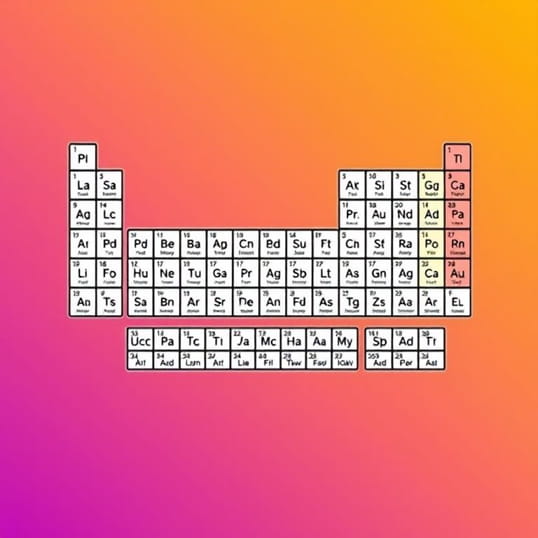
Compare Mendeleev And Modern Periodic Table
The development of the periodic table is one of the most significant achievements in the history of chemistry, providing a systematic way to organize and understand the elements. The original periodic table, created by Dmitri Mendeleev in 1869, laid the foundation for modern chemical organization. Since then, scientific advances, including the discovery of atomic numbers and electron configurations, have led to the creation of the modern periodic table. Comparing Mendeleev’s periodic table with the modern version highlights the evolution of chemical knowledge and the ways in which the organization of elements has become more precise and functional for modern chemistry.
Mendeleev’s Periodic Table
Dmitri Mendeleev, a Russian chemist, formulated the first widely recognized periodic table in 1869. He arranged the known elements in order of increasing atomic mass and noticed that elements with similar chemical properties appeared at regular intervals, or periods. This observation, known as the periodic law, allowed him to predict the existence and properties of elements that had not yet been discovered, making his table a powerful tool for chemists of the time.
Key Features of Mendeleev’s Table
- Arrangement by Atomic MassMendeleev organized elements according to their increasing atomic mass, which was the best indicator of periodicity at the time.
- Grouping by Chemical PropertiesElements with similar chemical behaviors were placed in the same vertical columns, called groups.
- Predictions of Undiscovered ElementsMendeleev left gaps in his table for elements that were unknown in 1869, accurately predicting their properties based on surrounding elements.
- Flexibility in PlacementIn some cases, Mendeleev reversed the order of elements to maintain consistency in chemical properties, demonstrating his practical approach over strict adherence to atomic mass.
Limitations of Mendeleev’s Table
While revolutionary, Mendeleev’s periodic table had certain limitations. Arranging elements strictly by atomic mass sometimes resulted in inconsistencies in the grouping of elements with similar properties. Additionally, the discovery of noble gases was not accounted for in Mendeleev’s original table, and the concept of atomic number, which is fundamental to the modern table, was not yet known. Despite these limitations, Mendeleev’s ability to predict unknown elements solidified the credibility and usefulness of his table.
Modern Periodic Table
The modern periodic table is based on the concept of atomic number rather than atomic mass. The atomic number, representing the number of protons in an atom’s nucleus, provides a more accurate and fundamental basis for arranging elements. The modern table also incorporates the understanding of electron configurations, which explains the periodicity of chemical properties and the formation of groups and periods. This structure has allowed chemists to classify all known elements systematically, including the noble gases, lanthanides, and actinides, providing a comprehensive framework for understanding chemical behavior.
Key Features of the Modern Periodic Table
- Arrangement by Atomic NumberElements are ordered by increasing atomic number, resolving inconsistencies seen in Mendeleev’s table based on atomic mass.
- Periodic Law Based on Electron ConfigurationChemical properties recur periodically due to repeating electron configurations across periods.
- Complete Inclusion of All ElementsModern periodic tables incorporate noble gases, lanthanides, and actinides, providing a complete representation of all known elements.
- Clear Group and Period StructureElements are organized into vertical groups and horizontal periods that reflect chemical similarity and periodic trends such as electronegativity, ionization energy, and atomic radius.
Advantages of the Modern Table
The modern periodic table offers several advantages over Mendeleev’s version. It eliminates the ambiguity caused by atomic mass discrepancies and provides a theoretical basis for chemical periodicity through electron configurations. Scientists can now explain trends in reactivity, bonding, and other chemical properties accurately. The modern table also facilitates the identification of unknown elements, prediction of chemical behavior, and design of new compounds in research and industry.
Comparing Mendeleev and Modern Periodic Tables
Comparing Mendeleev’s periodic table with the modern version highlights both the progress made in chemistry and the enduring insights of Mendeleev’s work. Both tables organize elements according to periodicity, but the modern table provides a more scientifically robust framework.
Basis of Arrangement
Mendeleev arranged elements primarily by atomic mass, sometimes adjusting order to match chemical properties, while the modern table strictly uses atomic number. This change corrected inconsistencies and provided a more fundamental understanding of periodic trends.
Prediction and Discovery of Elements
Mendeleev’s table predicted the existence of elements like gallium, scandium, and germanium, which were later discovered with properties close to his predictions. The modern periodic table, based on atomic numbers and electron configurations, allows for even more precise predictions and systematic classification, making it easier to integrate newly discovered elements.
Inclusion of Noble Gases
One of the major differences is the inclusion of noble gases in the modern table. These elements were discovered after Mendeleev’s initial table and fit naturally into the modern classification, completing the periodic trends and providing insight into chemical inertness and stability.
Scientific Understanding
Mendeleev’s table was empirical, based on observation and chemical properties, while the modern table is theoretical, grounded in atomic structure and quantum mechanics. Understanding electron configurations explains why elements exhibit specific chemical properties and why certain periodic trends occur, providing a scientific rationale absent in Mendeleev’s original formulation.
Significance of Both Tables
Both Mendeleev’s and the modern periodic tables are significant in the history of chemistry. Mendeleev’s table was instrumental in organizing chemical knowledge and predicting unknown elements, laying the groundwork for future developments. The modern table builds upon this foundation, offering a precise, comprehensive, and theoretically justified framework that underpins modern chemistry education, research, and industrial applications.
Impact on Education and Research
In education, both tables illustrate the evolution of scientific understanding, helping students appreciate the development of chemical theory. In research, the modern periodic table allows chemists to predict reactions, design new materials, and explore the properties of elements systematically. Mendeleev’s insights remain a teaching tool for demonstrating observation, pattern recognition, and predictive reasoning in science.
Comparing Mendeleev’s periodic table and the modern periodic table reveals the remarkable progress in chemical science over the past century and a half. Mendeleev’s arrangement by atomic mass, focus on chemical properties, and ability to predict unknown elements were groundbreaking at the time. The modern periodic table, organized by atomic number and informed by electron configurations, provides a complete and theoretically sound framework for understanding chemical behavior. Both tables have played vital roles in advancing chemistry, with Mendeleev’s work serving as a foundation and the modern table reflecting the culmination of continued research and discovery. Studying these tables together helps students, educators, and researchers appreciate the historical context, scientific reasoning, and practical applications that make the periodic table an essential tool in chemistry.