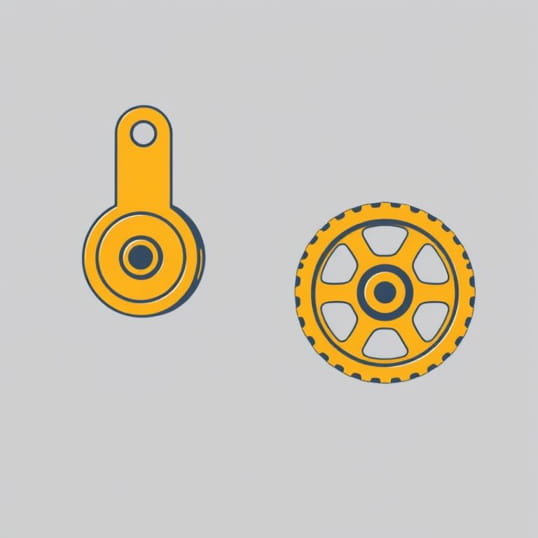
Examples Of Fixed Pulley And Movable Pulley
Pulleys are simple yet highly effective machines that have been used for centuries to lift and move heavy objects with ease. Understanding the different types of pulleys and their applications is essential in physics, engineering, and everyday problem-solving. Pulleys can be broadly classified into fixed pulleys and movable pulleys, each serving distinct purposes depending on the mechanical advantage required. By exploring examples of fixed and movable pulleys, we can better appreciate how these devices function and how they are applied in real-world situations, from construction sites to household use.
Fixed Pulley
A fixed pulley is a type of pulley that is attached to a support structure and does not move vertically. The wheel of the pulley remains stationary while the rope or belt passes over it. Fixed pulleys change the direction of the applied force, allowing a user to pull down on a rope to lift a load upward. However, a fixed pulley does not provide any mechanical advantage in terms of reducing the effort needed to lift the load; the force applied equals the weight of the object being lifted.
Characteristics of Fixed Pulleys
- The pulley is anchored to a fixed point and does not move.
- The primary function is to change the direction of force.
- No mechanical advantage; the input force equals the output force.
- Simple in design and easy to install.
Examples of Fixed Pulley
Fixed pulleys are widely used in everyday life and various industries. Some common examples include
- Flagpoles A fixed pulley at the top of the pole allows the flag to be raised or lowered by pulling the rope downward.
- Wells Traditional water wells use a fixed pulley attached to a support beam to lift buckets of water.
- Theater curtains Stage curtains are often operated using fixed pulleys to change the direction of pulling, making it easier for stagehands to raise and lower heavy drapes.
- Clotheslines Fixed pulleys help move clothes along the line, changing the direction of force applied to hang or remove laundry.
Movable Pulley
A movable pulley, unlike a fixed pulley, is not anchored to a support structure. Instead, it moves along with the load being lifted. The rope passes over the wheel of the movable pulley, which reduces the effort required to lift the load. Movable pulleys provide a mechanical advantage by allowing the user to apply less force than the weight of the load. This makes them highly effective for lifting heavier objects with minimal effort.
Characteristics of Movable Pulleys
- The pulley moves along with the load.
- Provides mechanical advantage, reducing the effort needed to lift the object.
- The distance over which the rope must be pulled increases proportionally to the mechanical advantage.
- Commonly used in combination with fixed pulleys to form compound pulley systems.
Examples of Movable Pulley
Movable pulleys are used in situations where reducing the effort to lift heavy loads is necessary. Examples include
- Construction cranes Movable pulleys in cranes allow heavy building materials to be lifted with less effort.
- Elevators Some elevator systems use movable pulleys to lift the cabin efficiently while distributing the weight.
- Sailing ships Movable pulleys are used in rigging systems to hoist sails and adjust their tension with minimal force.
- Exercise equipment Weight machines often incorporate movable pulleys to reduce the force needed to lift weights, making workouts manageable and safe.
Compound Pulley Systems
Both fixed and movable pulleys can be combined to create a compound pulley system, also known as a block and tackle. This setup maximizes the mechanical advantage and makes it possible to lift very heavy loads with relatively little effort. Compound pulleys use one or more fixed and movable pulleys together, distributing the load across multiple ropes and effectively reducing the force required. These systems are commonly seen in construction sites, shipping docks, and industrial machinery where efficiency and safety are crucial.
Examples of Compound Pulley Systems
- Construction hoists Using multiple fixed and movable pulleys to lift heavy construction materials.
- Stage rigging Large theater productions often use compound pulley systems to manage lighting, props, and scenery.
- Marine applications Cargo handling on ships frequently employs block and tackle systems to move heavy containers safely.
Advantages of Using Pulleys
Pulleys, whether fixed, movable, or compound, offer several benefits that make them indispensable in lifting and moving tasks. These advantages include
- Reduction of effort required to lift heavy objects, especially with movable and compound pulleys.
- Ability to change the direction of force, making lifting or pulling more convenient and ergonomic.
- Flexibility in installation and application, from small household tasks to large industrial projects.
- Enhanced safety by distributing weight and reducing strain on the user.
- Cost-effective and durable solutions for repetitive lifting and moving tasks.
Understanding the differences between fixed and movable pulleys, along with their practical examples, highlights the versatility and utility of pulleys in various fields. Fixed pulleys provide a simple means to change the direction of force without reducing effort, making them ideal for basic lifting tasks such as raising flags or drawing water from wells. Movable pulleys, on the other hand, offer a mechanical advantage that reduces the effort needed to lift heavier loads, making them essential in construction, marine, and industrial applications.
By exploring both fixed and movable pulleys, as well as their combinations in compound systems, it becomes clear that pulleys are not only simple machines but also highly effective tools for enhancing efficiency and safety. Their widespread use across different domains demonstrates their importance in both historical and modern contexts. Understanding these examples enables students, engineers, and everyday users to apply pulley systems effectively, improving productivity and reducing physical strain.
In summary, fixed and movable pulleys each serve distinct purposes. Fixed pulleys change the direction of force, while movable pulleys reduce the effort required to lift a load. By examining examples of both types, we can appreciate the ingenuity and practicality of pulley systems, which continue to play a vital role in lifting, transportation, and mechanical operations worldwide.