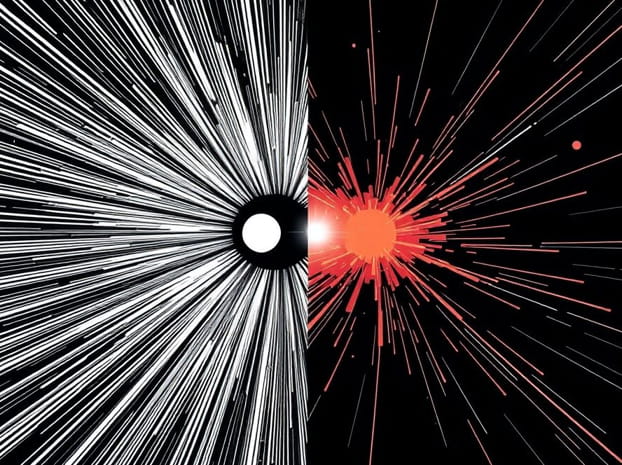
Gamma Ray Burst Vs Supernova
When astronomers study the violent events of the universe, two of the most fascinating phenomena are gamma ray bursts and supernovae. Both involve the death of massive stars, both release extraordinary amounts of energy, and both shape the evolution of galaxies. Yet they are not the same. A gamma ray burst is the most energetic explosion known, producing brief flashes of high-energy radiation, while a supernova is the dramatic collapse and explosion of a star that leaves behind a remnant. To understand gamma ray burst vs supernova, one must compare their origins, characteristics, energy scales, and effects on the cosmos.
Defining Gamma Ray Bursts
A gamma ray burst, often abbreviated as GRB, is a sudden and intense release of gamma radiation lasting from a fraction of a second to several minutes. These bursts are detected by space-based observatories because Earth’s atmosphere blocks gamma rays. They are believed to result from either the collapse of massive stars into black holes or the merger of compact objects such as neutron stars. The radiation is focused into narrow jets, which explains why only certain events are visible from Earth.
Defining Supernovae
A supernova, by contrast, is a stellar explosion that occurs when a massive star reaches the end of its life cycle or when a white dwarf undergoes runaway nuclear fusion. Unlike a gamma ray burst, a supernova shines across the electromagnetic spectrum, from radio waves to visible light. They can remain visible for weeks or even months. Supernovae scatter heavy elements into space, which later become part of new stars, planets, and even life itself.
Duration and Visibility
One of the major differences in the discussion of gamma ray burst vs supernova is their duration. A GRB is extremely brief, often lasting less than a minute, while a supernova can remain visible for much longer periods. Observers may catch a GRB only through specialized equipment, while a supernova can sometimes be seen with the naked eye if it occurs in a nearby galaxy.
Key Differences in Duration
- Gamma ray burstSeconds to minutes in length, fading rapidly.
- SupernovaWeeks or months of brightness after the explosion.
Energy Output
When comparing energy scales, gamma ray bursts are far more intense during their brief flashes. In just a few seconds, a GRB can release more energy than the Sun will emit during its entire lifetime. A supernova, though immensely powerful, releases less energy per unit of time but spreads it out over longer durations. Both events, however, are among the most energetic known in the universe.
Origins and Causes
The causes of gamma ray bursts and supernovae reveal both their similarities and differences. A long-duration GRB usually occurs when a massive star collapses into a black hole, an event known as a hypernova. Short-duration GRBs are linked to mergers of neutron stars. Supernovae, on the other hand, occur in two main types core-collapse supernovae from massive stars and thermonuclear supernovae from white dwarfs in binary systems.
Types of Supernova
- Core-collapse supernovaDeath of a star more than eight times the Sun’s mass.
- Type Ia supernovaWhite dwarf explosion triggered by accumulating matter from a companion star.
Observational Differences
For astronomers, the observational signatures of gamma ray bursts vs supernovae are crucial. GRBs are detected primarily in the gamma ray part of the spectrum, followed by afterglows in X-ray, optical, and radio bands. Supernovae, however, are identified by their bright light curves in optical wavelengths, their spectral lines, and their expanding shells of gas.
Aftereffects in Space
Both gamma ray bursts and supernovae leave lasting marks on the cosmos. A GRB can produce jets that pierce through interstellar material, potentially affecting nearby star systems. A supernova enriches space with heavy elements like iron, oxygen, and carbon. Without supernovae, planets like Earth and the building blocks of life would not exist. Thus, both explosions are essential drivers of cosmic evolution, though in different ways.
Danger to Earth
When considering gamma ray burst vs supernova, one of the dramatic questions is their potential impact on Earth. A nearby supernova could damage Earth’s atmosphere with radiation, but such an event is rare. A GRB aimed directly at Earth could be even more catastrophic, stripping the ozone layer and disrupting ecosystems. Fortunately, GRBs are usually very far away, occurring billions of light-years from us.
Historical Records
Supernovae have been observed throughout history, often recorded by ancient astronomers. Famous examples include the supernova of 1054, which created the Crab Nebula, and Tycho’s supernova of 1572. Gamma ray bursts, however, were not discovered until the 1960s, when satellites detected them accidentally during the Cold War. This makes GRBs a more modern field of study compared to supernovae, which humans have documented for centuries.
Comparison in Astronomy Research
Scientists study both phenomena to learn about extreme physics, black hole formation, and the evolution of galaxies. Supernovae serve as standard candles in measuring cosmic distances, especially Type Ia supernovae. Gamma ray bursts, meanwhile, are used as probes to study the early universe, since they can be detected even from billions of light-years away.
Gamma Ray Burst vs Supernova A Summary
While both gamma ray bursts and supernovae mark the violent deaths of stars, their characteristics differ in important ways
- GRBs are extremely brief but release immense amounts of energy.
- Supernovae are longer-lasting and enrich the cosmos with heavy elements.
- GRBs are often linked to hypernovae or compact object mergers, while supernovae arise from core collapse or white dwarf explosions.
- Supernovae can sometimes be seen without telescopes, but GRBs require specialized detection equipment.
The comparison of gamma ray burst vs supernova reveals the universe’s most powerful explosions and the different roles they play in shaping cosmic history. Gamma ray bursts are the intense flashes that signal the most energetic moments of stellar death, while supernovae are the brilliant spectacles that forge the elements necessary for life. Both events inspire awe and curiosity, reminding us of the dynamic and sometimes violent processes that govern the stars. By studying them, astronomers not only uncover the secrets of stellar evolution but also gain insights into the origins of galaxies, planets, and even humanity itself.