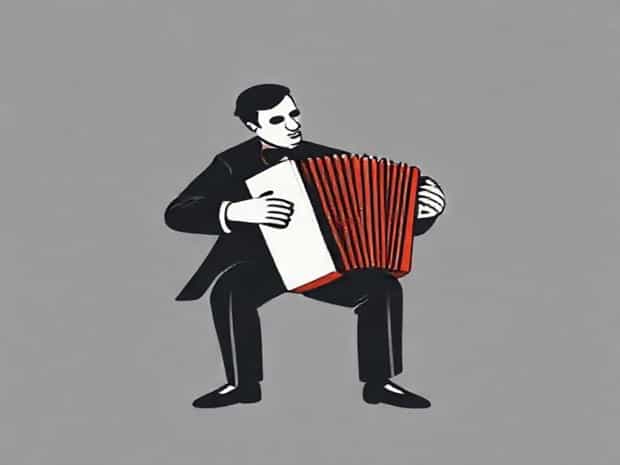
Marc Chagall The Accordionist
Marc Chagall, a pioneer of modern art, is renowned for his dreamlike compositions, vivid color palette, and imaginative depictions of daily life and folklore. Among his many works, The Accordionist” stands out as a testament to his unique ability to merge musicality, memory, and surrealism on canvas. Painted in 1911, this piece reflects Chagall’s fascination with Jewish culture, village life in Vitebsk, and the influence of Cubism and Fauvism that he encountered during his time in Paris. “The Accordionist” captures a fleeting moment of musical performance while simultaneously evoking a sense of nostalgia, spirituality, and whimsical abstraction. Understanding this painting offers insight into Chagall’s evolving style and the broader context of early 20th-century art.
Background of Marc Chagall
Marc Chagall was born in 1887 in Vitebsk, then part of the Russian Empire. He grew up immersed in Jewish traditions and rural village life, both of which profoundly influenced his artistic vision. Early exposure to religious customs, folklore, and family rituals provided Chagall with a rich tapestry of imagery that would later populate his paintings. In 1910, Chagall moved to Paris, where he encountered avant-garde movements such as Cubism, Fauvism, and Expressionism. These influences merged with his personal memories and cultural heritage, resulting in a style that is immediately recognizable for its poetic quality, floating figures, and vibrant colors. “The Accordionist” emerges from this formative period, showcasing his ability to synthesize tradition with modernist experimentation.
Chagall’s Early Paris Period
- Exposure to Cubism introduced him to fragmented perspectives and geometric forms.
- Fauvism inspired his bold use of color, enhancing emotional expression.
- He began integrating personal narrative and folklore into avant-garde techniques.
- The juxtaposition of memory and modernism became a hallmark of his style.
The Accordionist Composition and Subject
“The Accordionist” depicts a musician engrossed in playing his instrument, set against a backdrop of abstract shapes and expressive lines. The figure of the accordionist appears elongated, with exaggerated proportions that emphasize movement and rhythm. Chagall uses contrasting colors and fragmented planes to create a sense of musicality, where visual elements seem to vibrate with the energy of the performance. The painting reflects Chagall’s fascination with music as a metaphor for joy, cultural identity, and emotional expression. The accordion itself is a symbol of communal entertainment in Eastern European Jewish villages, reinforcing the painting’s ties to memory and heritage.
Visual Analysis
- Use of vivid blues, reds, and yellows to convey vibrancy and emotional resonance.
- Angular forms and fragmented shapes influenced by Cubism suggest movement and rhythm.
- Floating figures and distorted proportions reflect Chagall’s surreal and poetic style.
- Integration of folkloric symbols emphasizes cultural and personal memory.
- Balance between abstraction and representation creates a dreamlike atmosphere.
Symbolism and Cultural Significance
Chagall’s work often blends personal, cultural, and universal symbolism, and “The Accordionist” is no exception. The musician embodies the spirit of Eastern European Jewish life, highlighting the role of music in communal gatherings and personal expression. The accordion, a portable and popular instrument, symbolizes both joy and continuity within the community. Chagall’s floating figures and skewed perspectives suggest a connection between the physical and spiritual realms, transforming a simple scene of musical performance into a poetic meditation on memory, identity, and emotion. Through symbolism, the painting transcends literal depiction to evoke the inner world of experience and feeling.
Key Symbolic Elements
- Accordion Represents music, celebration, and cultural heritage.
- Floating figures Suggest memory, imagination, and spiritual transcendence.
- Vivid colors Convey emotion, energy, and psychological depth.
- Geometric planes Reflect Cubist influence and abstract interpretation of reality.
- Village motifs Evoke Chagall’s personal history and Eastern European Jewish culture.
Techniques and Style
Chagall’s innovative approach in “The Accordionist” demonstrates his mastery of combining traditional and modern techniques. He employs oil on canvas, layering pigments to achieve luminous color effects. His use of line, shape, and perspective diverges from realism, favoring emotional resonance over literal representation. By blending Cubist structure with expressive color and personal narrative, Chagall creates a unique visual language that captures the rhythm of music and the essence of memory. This synthesis of styles became a defining characteristic of his oeuvre and influenced subsequent generations of modern artists.
Artistic Techniques in the Painting
- Layered oil paints for depth and vibrancy.
- Exaggerated proportions to convey motion and focus.
- Fragmented forms inspired by Cubism to create visual tension.
- Expressive brushstrokes and color contrasts to evoke emotion.
- Integration of symbolic elements to enhance narrative and meaning.
Reception and Influence
“The Accordionist” was part of Chagall’s early explorations that gained recognition among avant-garde circles in Paris. Critics and collectors appreciated his ability to merge cultural memory with modernist experimentation. The painting contributed to Chagall’s growing reputation as an artist who could translate personal and communal experience into universal visual language. Over time, Chagall’s approach influenced Surrealists, Expressionists, and other modern artists who sought to blend emotion, symbolism, and abstraction. “The Accordionist” remains a key example of how Chagall’s innovative style transformed traditional subjects into imaginative, timeless works of art.
Legacy of the Work
- Showcases Chagall’s fusion of folklore, memory, and modernist style.
- Demonstrates early 20th-century influences on personal artistic expression.
- Serves as an important reference for understanding Chagall’s development as a painter.
- Inspires contemporary artists exploring narrative, symbolism, and abstraction.
- Highlights the enduring connection between music, culture, and visual art.
Marc Chagall’s “The Accordionist” exemplifies the artist’s ability to transform ordinary scenes into extraordinary visual narratives. By combining vibrant color, abstract form, and cultural symbolism, Chagall captures not only the physical act of playing music but also the emotional and spiritual resonance that music brings to communal and personal life. The painting reflects his roots in Vitebsk, his exposure to Parisian avant-garde movements, and his ongoing fascination with memory, identity, and folklore. Its composition, symbolism, and technique illustrate why Chagall remains a pivotal figure in modern art, bridging traditional subjects with innovative expression. “The Accordionist” continues to captivate audiences, demonstrating the timeless appeal of Chagall’s imaginative vision.
Through “The Accordionist,” viewers are invited to experience the interplay of culture, memory, and artistic experimentation. Chagall’s synthesis of Eastern European Jewish heritage with modernist innovation creates a work that is both personal and universal. As a painting, it transcends time and place, allowing audiences to connect with the vibrancy, rhythm, and emotion that define his unique approach to art. Understanding this work enriches appreciation not only for Chagall’s genius but also for the ways in which music, memory, and imagination can intersect on canvas to create enduring, shapely expressions of human experience.