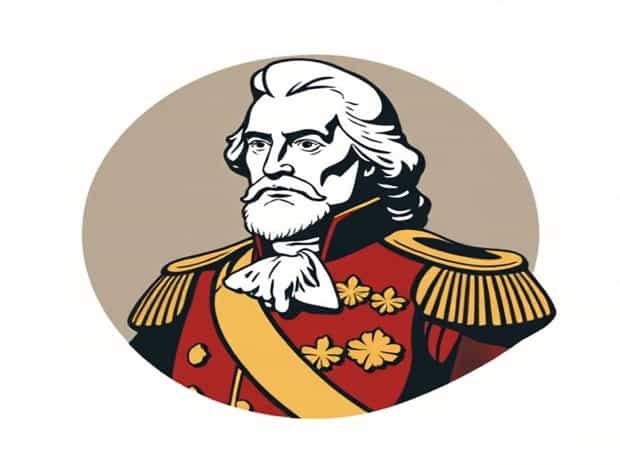
Major General Horatio Gates
Major General Horatio Gates was a significant figure in the American Revolutionary War, remembered for his leadership, his triumph at Saratoga, and his controversial role in later campaigns. Born in England but finding his destiny in America, Gates lived a life filled with ambition, opportunity, and dramatic turns. His career highlights both the challenges of military leadership and the fragile balance of reputation during one of the most transformative periods in American history. To understand his impact, one must explore his early life, his rise through the ranks, his moments of glory, and his decline after one of the war’s greatest defeats.
Early Life and Background
Horatio Gates was born in Maldon, Essex, England, in 1727. His family was not wealthy, but Gates pursued opportunities through education and military service. Like many young men of his time, he sought a career in the British Army. He served in various colonial wars, including the French and Indian War, where he gained valuable battlefield experience. This early exposure to North America would shape his later decision to join the fight for American independence.
Service in the British Army
Gates’ time in the British Army helped him develop skills in organization and command. He served as a staff officer under General Edward Braddock during the ill-fated expedition against French forces in 1755. Despite Braddock’s defeat, Gates learned important lessons about logistics, discipline, and the challenges of warfare in the colonies. His service gave him insight into both British strengths and weaknesses, knowledge that would later prove vital when he joined the American cause.
Joining the American Revolution
By the time tensions between Britain and the American colonies escalated, Horatio Gates had settled in Virginia. He purchased land and integrated himself into colonial society. When the Revolutionary War broke out in 1775, Gates offered his military expertise to the Continental Congress. His prior experience made him an attractive candidate for leadership, and he was quickly commissioned as a brigadier general in the Continental Army.
Role in the Continental Army
Gates initially served as adjutant general, responsible for administrative duties and helping to organize the fledgling Continental Army. His attention to detail and ability to instill order earned him respect. Soon, he sought a field command, eager to prove himself on the battlefield. His ambition and confidence positioned him as one of the more prominent leaders of the revolution.
The Battle of Saratoga
The turning point in Horatio Gates’ career came in 1777 during the Saratoga campaign. British General John Burgoyne led an invasion from Canada, hoping to cut New England off from the rest of the colonies. Gates was appointed to command the American forces opposing this advance. The resulting series of engagements culminated in the Battle of Saratoga, where the Americans won a decisive victory.
Victory and Recognition
The surrender of Burgoyne’s army in October 1777 was a massive boost for the American cause. Saratoga is often called the turning point of the Revolutionary War because it convinced France to enter the conflict as an ally of the United States. Gates received much of the credit for the victory, and his reputation soared. Some contemporaries even saw him as a possible replacement for George Washington as commander-in-chief.
Controversy over Leadership
Despite his triumph, Gates’ actual role at Saratoga has been debated. Some historians argue that much of the credit should go to Benedict Arnold, whose aggressive leadership on the battlefield was instrumental. Gates, on the other hand, remained cautious, preferring defensive strategies. This controversy over who deserved recognition became part of Gates’ complicated legacy.
The Conway Cabal
Following Saratoga, Gates’ rising fame led to political intrigue. A group of officers and politicians, dissatisfied with Washington’s leadership, considered Gates as a possible alternative. This episode, known as the Conway Cabal, created tension within the Continental Army. While Gates did not openly conspire against Washington, his name was associated with the movement, straining their relationship. Washington survived the political challenge, but Gates’ reputation began to suffer.
The Southern Campaign
In 1780, Gates was given command of American forces in the southern colonies. The British, under Lord Cornwallis, were pressing their advantage in the South, and Congress hoped Gates’ reputation as the hero of Saratoga could turn the tide. Unfortunately, this appointment would prove disastrous for both Gates and his army.
The Battle of Camden
On August 16, 1780, Gates faced Cornwallis at the Battle of Camden in South Carolina. The battle was a catastrophe for the Americans. Poor planning, lack of supplies, and inexperienced troops contributed to the defeat. The militia on the left flank fled early in the engagement, and the Continental forces were overwhelmed. Gates himself retreated from the battlefield, later criticized for abandoning his men. The defeat at Camden marked the lowest point in his career.
Aftermath of Camden
The failure at Camden destroyed Gates’ reputation. He was removed from command and subjected to an inquiry, though no formal charges were brought against him. His earlier glory was overshadowed by this humiliating defeat. Nathanael Greene replaced him in the South, and under Greene’s leadership, the Continental forces slowly regained strength and momentum.
Later Life
After his removal from command, Gates retired from active military service. He returned to his estate in Virginia, living a quieter life. Eventually, he moved to New York, where he spent his final years. Gates died in 1806, largely out of the public eye. His legacy remained mixed, celebrated for Saratoga but tarnished by Camden.
Legacy of Horatio Gates
Major General Horatio Gates occupies a unique place in American history. His role in the victory at Saratoga secured him a place among the notable figures of the Revolution, but his failures and political entanglements prevented him from achieving lasting greatness. Gates serves as a reminder of both the opportunities and the perils faced by military leaders in times of upheaval.
Strengths as a Leader
- Organizational skills that helped shape the early Continental Army.
- Success at Saratoga, one of the most decisive battles of the Revolution.
- Ability to gain political support and recognition from Congress.
Weaknesses and Criticism
- Overly cautious strategies that limited battlefield initiative.
- Association with the Conway Cabal, which undermined unity.
- Disastrous defeat at Camden, damaging his reputation permanently.
Major General Horatio Gates remains a complex and controversial figure in Revolutionary War history. His rise to prominence at Saratoga demonstrated his capability and earned him fame, but his subsequent failures exposed the limits of his leadership. Gates’ story highlights the fragile nature of military reputation and the pressures of commanding during a war for independence. While not remembered with the same reverence as George Washington or Nathanael Greene, Gates played a pivotal role in shaping the course of the Revolution. His legacy endures as both a cautionary tale and a reminder of the human struggles behind America’s fight for freedom.