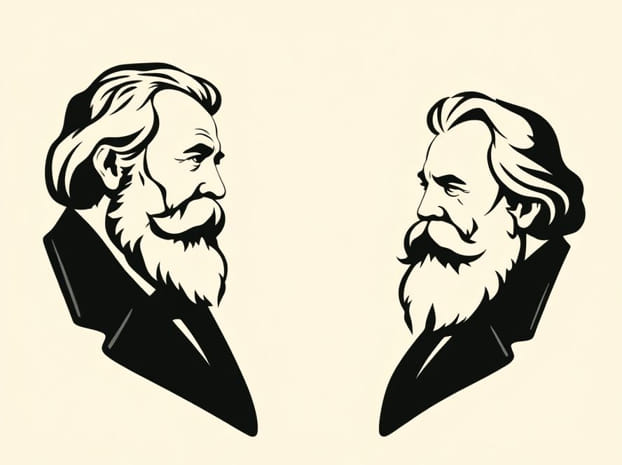
Friedrich Engels And Karl Marx
The story of Friedrich Engels and Karl Marx is one of the most influential collaborations in modern intellectual and political history. Their names are forever linked because of their shared vision of society, their contributions to philosophy, and their revolutionary critique of capitalism. These two thinkers shaped not only political theory but also social movements across the world. Understanding their partnership, ideas, and historical context helps explain why their legacy continues to spark debates today. The connection between Friedrich Engels and Karl Marx was not only intellectual but also personal, as Engels provided both financial and moral support to Marx throughout his life, ensuring that their joint ideas would survive and spread.
Early Backgrounds
Karl Marx
Karl Marx was born in 1818 in Trier, in what is now Germany. He studied philosophy and was influenced by thinkers such as Hegel. His interest lay in understanding the structures of society and the forces that drive historical change. His doctoral thesis showed his early commitment to philosophy, but his political writings later defined his place in history.
Friedrich Engels
Friedrich Engels, born in 1820 in Barmen (now Wuppertal, Germany), came from a wealthy industrial family. Unlike Marx, Engels had direct experience with industrial capitalism through his family’s textile business in Manchester, England. This exposure shaped his understanding of working-class struggles and later provided a practical foundation for the theories he developed with Marx.
The Meeting of Minds
Marx and Engels first met in the 1840s. Their friendship quickly deepened into collaboration, as both were committed to critiquing capitalist society and imagining alternatives. Engels’ firsthand experiences of industrial conditions complemented Marx’s theoretical rigor. Together, they crafted a framework for understanding class struggle as the engine of history.
The Communist Manifesto
One of their most famous works isThe Communist Manifesto, published in 1848. Commissioned by the Communist League, this pamphlet outlined their shared vision of a world where workers, united across national borders, would overthrow the bourgeoisie. Its famous opening line about the specter of communism remains one of the most quoted political statements in history.
- The manifesto argued that history is shaped by class conflict.
- It criticized the exploitation of workers under capitalism.
- It called for workers of the world to unite.
Although written over 150 years ago, the text still resonates in discussions about inequality, globalization, and labor rights. This joint work represents the pinnacle of their collaboration, blending Marx’s analytical depth with Engels’ accessible writing style.
Das Kapital and Engels’ Support
Marx’s magnum opus,Das Kapital, was published in 1867. It provided a detailed critique of capitalism, focusing on how labor produces value and how capitalists extract surplus value from workers. However, Marx often struggled financially while writing it. Engels played a vital role in supporting Marx and his family, sending funds from his own business income to allow Marx to continue his research.
After Marx’s death in 1883, Engels dedicated himself to editing and publishing the remaining volumes ofDas Kapital. Without Engels’ commitment, much of Marx’s theoretical work might never have reached the public. This effort shows the depth of their partnership and Engels’ belief in their shared mission.
Philosophical Contributions
Historical Materialism
One of their most important ideas was historical materialism. This theory argued that material conditions such as economic systems determine the structure of society and influence culture, politics, and ideology. In their view, history progresses through stages driven by class struggle.
Critique of Capitalism
Marx and Engels analyzed capitalism not only as an economic system but as a social order that shapes human relations. They believed it was inherently unstable, prone to crises, and ultimately unsustainable. Their writings predicted that capitalism would eventually give way to socialism, and later, communism.
Impact on Social Movements
The ideas of Friedrich Engels and Karl Marx fueled revolutions and inspired political movements worldwide. From the labor unions of the 19th century to socialist and communist parties across Europe and Asia, their works provided a framework for collective action. While interpretations of their ideas varied, their critique of inequality and exploitation remained at the center of many struggles for justice.
- Labor movements used their ideas to push for better working conditions.
- Revolutionary leaders adapted Marxist thought to their local contexts.
- Academics debated and expanded their theories in philosophy, economics, and sociology.
Differences Between Engels and Marx
Although united by a common cause, Engels and Marx were not identical in their approaches. Engels was often more pragmatic, with a focus on practical matters such as military theory and the organization of workers. Marx, on the other hand, was more deeply rooted in philosophical analysis. Yet these differences made their collaboration stronger, as they complemented each other’s strengths.
Criticisms and Controversies
The legacy of Engels and Marx is not without criticism. Some argue that their predictions about capitalism’s collapse were too simplistic, as capitalism has proven adaptable and resilient. Others point to the authoritarian regimes of the 20th century that claimed to follow Marxism but often deviated from its principles. Critics also debate whether Engels simplified Marx’s ideas when he edited and published his works. Nonetheless, their intellectual contributions remain undeniable.
Engels’ Later Years
After Marx’s death, Engels became the primary defender and promoter of their ideas. He continued writing on topics such as family, religion, and science, always linking them to the materialist view of history. Engels lived until 1895, leaving behind a large body of work that extended their shared project.
Why Their Partnership Matters
The story of Friedrich Engels and Karl Marx is not just about two individuals but about the power of collaboration. Engels’ financial support and editorial efforts allowed Marx to focus on writing. Marx’s theoretical brilliance provided the foundation for Engels’ activism. Together, they created ideas that went far beyond their lifetimes, influencing millions of people and shaping the course of history.
Continuing Relevance Today
Even in the 21st century, the writings of Engels and Marx remain relevant. Discussions about economic inequality, globalization, and the power of corporations often draw on their critiques of capitalism. Their call for solidarity among workers resonates in movements that demand fair wages, sustainable economies, and social justice.
The partnership between Friedrich Engels and Karl Marx was one of the most remarkable intellectual collaborations in history. Engels brought lived experience of industrial capitalism and tireless dedication, while Marx contributed deep philosophical insight and groundbreaking theory. Together, they produced a body of work that continues to shape political thought and inspire movements for social change. Their ideas, though debated and sometimes contested, remain part of the foundation for understanding modern society and its struggles. To study Engels and Marx is to explore the roots of critical theory and the enduring search for a more just world.