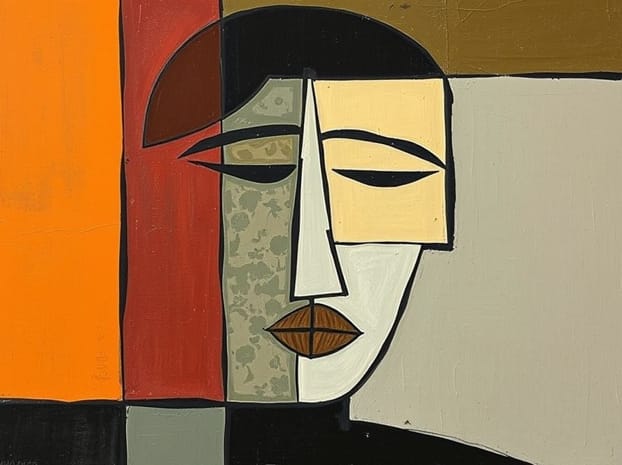
Cubism Paintings By Georges Braque
Georges Braque, one of the pioneering figures of modern art, played a crucial role in developing Cubism, a revolutionary movement that changed the way artists approached form, perspective, and composition. His Cubist paintings challenge traditional notions of representation, breaking objects into geometric shapes and exploring multiple viewpoints simultaneously. Through his innovative approach, Braque collaborated closely with Pablo Picasso to redefine the visual language of the 20th century. His work demonstrates a sophisticated understanding of color, texture, and spatial relationships, making his Cubist paintings both intellectually stimulating and visually striking. By examining Braque’s body of work, one can gain insight into the evolution of Cubism and the broader impact of his artistic experimentation.
Early Life and Influences
Georges Braque was born in Argenteuil, France, in 1882. Initially trained as a decorator and studied under Fernand Cormon, he was influenced by Fauvism early in his career, experimenting with bold colors and expressive brushwork. However, his artistic direction shifted dramatically after encountering the works of Paul Cézanne. Cézanne’s focus on underlying geometric forms and his treatment of space inspired Braque to explore structure over naturalistic representation. This inspiration laid the groundwork for his later innovations in Cubism, where he began to deconstruct objects into simplified planes and facets.
The Birth of Cubism
Cubism emerged around 1907-1914, primarily through the collaboration between Georges Braque and Pablo Picasso. Unlike traditional painting, which emphasized realistic perspective and naturalistic depiction, Cubism sought to represent multiple angles of an object simultaneously. Braque’s early Cubist paintings, often referred to as Analytic Cubism, feature muted color palettes dominated by browns, grays, and ochres. These works focus on the structure and form of objects rather than their superficial appearance, challenging viewers to perceive the essence of the subject through fragmented planes and overlapping shapes.
Key Features of Braque’s Cubist Paintings
Several defining characteristics distinguish Georges Braque’s Cubist works. His paintings often depict still lifes, musical instruments, and domestic objects, transforming them into geometric compositions. He meticulously arranged planes to create a sense of depth while simultaneously flattening the image to disrupt conventional perspective. Texture and brushwork are integral, with Braque often incorporating collage elements or experimenting with different media to enhance the tactile quality of his work. His use of muted tones in Analytic Cubism allows the viewer to focus on form and structure, while his later Synthetic Cubism introduced brighter colors and decorative patterns, emphasizing the interplay of shape, surface, and space.
Analytic Cubism
Analytic Cubism, developed between 1908 and 1912, represents Braque’s most intense exploration of form and structure. In paintings such as Violin and Palette” and “The Portuguese,” objects are fragmented into overlapping planes, with multiple viewpoints combined into a single composition. The muted palette minimizes distractions, allowing the viewer to concentrate on geometric analysis. These works reveal Braque’s fascination with the interplay of volume, space, and perspective, and his ability to create a dynamic rhythm through careful arrangement of shapes.
Synthetic Cubism
After 1912, Braque’s approach evolved into Synthetic Cubism, characterized by simpler shapes, brighter colors, and the introduction of collage elements. In this phase, Braque often used materials like wallpaper, newspaper, and sand to create textured surfaces, integrating them seamlessly into the composition. Synthetic Cubism focused less on dissecting objects and more on constructing them from basic elements, emphasizing decorative and playful qualities. Works such as “Fruit Dish and Glass” exemplify this approach, where geometric forms interact with patterns and textures to create visually engaging compositions that balance abstraction with recognizability.
Use of Color and Texture
Color in Braque’s Cubist paintings serves both structural and aesthetic purposes. In Analytic Cubism, muted tones create a cohesive, harmonious composition that directs attention to form rather than color. In Synthetic Cubism, brighter and contrasting colors add visual interest and dynamism. Texture, whether through brushwork, impasto, or collage, enhances the sensory experience of the painting, making the surface itself a critical element of meaning. Braque’s careful consideration of color and texture contributes to the depth and complexity of his Cubist works, making each painting a study in both form and material.
Notable Works
- “Violin and Palette” (1909)A hallmark of Analytic Cubism, this painting depicts a fragmented violin and painter’s palette, exploring multiple viewpoints in a subdued color scheme.
- “Houses at L’Estaque” (1908)An early work demonstrating Braque’s move towards geometric simplification of landscapes, influenced by Cézanne.
- “Bottle and Fishes” (1910-1912)Combines fragmented planes and overlapping perspectives, characteristic of Analytic Cubism’s complex visual structure.
- “Fruit Dish and Glass” (1912)An example of Synthetic Cubism, featuring collage elements and brighter colors that emphasize construction over dissection.
Collaboration with Picasso
Braque’s collaboration with Pablo Picasso was crucial in the development of Cubism. Between 1908 and 1914, the two artists shared ideas, techniques, and approaches, pushing each other to explore abstraction and form. This partnership fostered a competitive yet highly productive environment, leading to breakthroughs in both Analytic and Synthetic Cubism. While their styles remained distinct, the mutual influence of their experimentation solidified Cubism as a transformative movement in modern art.
Legacy of Georges Braque
Georges Braque’s contributions to Cubism extend beyond his individual works. He helped redefine the possibilities of visual representation, influencing countless artists and movements throughout the 20th century. His innovative use of geometry, multiple perspectives, and textural experimentation laid the groundwork for future abstract and modernist art. Braque’s Cubist paintings continue to be studied, exhibited, and celebrated for their technical mastery, conceptual depth, and enduring impact on the evolution of artistic expression.
Modern Appreciation
Today, Braque’s Cubist paintings are valued not only for their historical significance but also for their aesthetic and intellectual appeal. Museums around the world showcase his works, allowing new generations to engage with the revolutionary ideas behind Cubism. Art scholars analyze his methods of deconstructing and reconstructing forms, while collectors and enthusiasts appreciate the beauty, complexity, and innovation inherent in each painting. Braque’s legacy endures as a testament to the power of collaboration, experimentation, and vision in the world of art.
Georges Braque’s Cubist paintings represent a fundamental shift in the way artists perceive and depict the world. By breaking objects into geometric planes, exploring multiple viewpoints, and experimenting with texture and color, Braque challenged conventional representation and opened new possibilities for artistic expression. His work in both Analytic and Synthetic Cubism demonstrates an extraordinary balance of intellectual rigor and aesthetic sensitivity. As a pioneer of modern art, Braque’s contributions remain influential, offering inspiration, insight, and appreciation for the transformative power of creativity and innovation in the visual arts.