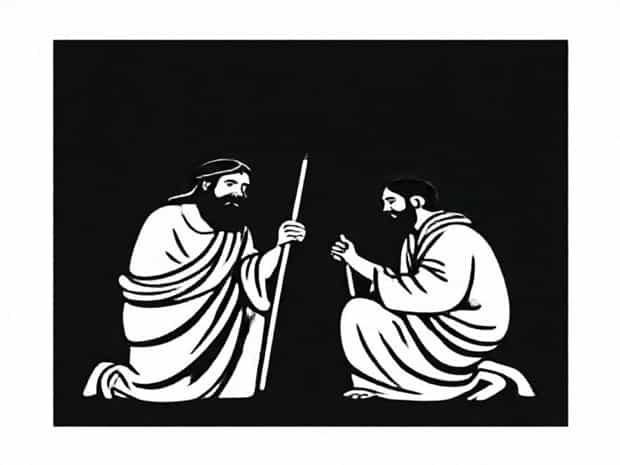
Joseph Campbell Doubting Thomas
The story of Doubting Thomas has been retold countless times as an illustration of faith, skepticism, and the human search for certainty. In Christian tradition, Thomas the Apostle earned his nickname for demanding tangible proof of Christ’s resurrection before believing. Joseph Campbell, the renowned mythologist, found deep symbolic meaning in such stories, interpreting them as universal expressions of human struggles with belief and doubt. When Campbell discussed the story of Doubting Thomas, he highlighted not just the religious dimension, but also the psychological and mythological themes that resonate far beyond Christianity. His perspective offers a way to understand why this narrative continues to speak to people across cultures and time.
Joseph Campbell and the Power of Myth
Joseph Campbell dedicated much of his career to exploring myths, symbols, and archetypes that appear in cultures throughout history. In his famous works on mythology, he emphasized the monomyth or hero’s journey, but he also analyzed religious stories with the same lens. Campbell viewed biblical narratives, including the account of Doubting Thomas, as part of a broader tapestry of myths that reflect universal human experiences.
Why Campbell’s Perspective Matters
- He saw myths as maps of the human spirit, guiding people through life’s mysteries.
- He believed that religious stories reveal symbolic truths even if they are not always taken literally.
- By interpreting figures like Doubting Thomas, Campbell showed how doubt and belief coexist as essential parts of human experience.
In this way, Campbell did not reduce Thomas to a historical figure but elevated him to a symbolic character representing universal human doubt.
The Biblical Story of Doubting Thomas
Before looking at Campbell’s interpretation, it is helpful to recall the original account. In the Gospel of John, Thomas was not present when Jesus first appeared to the disciples after the resurrection. When told by others that Jesus had risen, Thomas declared that he would not believe unless he could touch the wounds of Christ. Later, when Jesus appeared again, Thomas was invited to place his hands on the wounds. Overwhelmed, he confessed, My Lord and my God.
The Meaning in Christian Tradition
In traditional Christian teaching, the story is often used as a lesson about faith. It emphasizes the blessing of believing without seeing and demonstrates the mercy of Christ in meeting Thomas’s doubts directly. Thomas becomes a figure who embodies both skepticism and the transformative power of faith.
Campbell’s Interpretation of Doubting Thomas
Joseph Campbell did not reject the Christian meaning but expanded the story’s significance by placing it in the context of mythology and psychology. For Campbell, Doubting Thomas represents the universal human need for direct experience before accepting transcendent truths. This echoes his broader belief that myths serve as symbolic roadmaps, pointing to truths that can only be grasped through personal encounter and inner transformation.
Doubt as a Universal Archetype
Campbell often emphasized archetypes, recurring figures and themes that appear across cultures. Doubting Thomas fits into an archetypal role the skeptic who demands proof. This archetype can be found in other traditions as well
- In Greek myths, figures like Odysseus often question divine interventions.
- In Hindu traditions, seekers sometimes demand signs from the gods.
- In modern literature, skeptical heroes often serve as stand-ins for readers who need to be convinced of the story’s truth.
By linking Thomas to these broader patterns, Campbell demonstrated how doubt is not a flaw but a natural stage in the human journey toward deeper understanding.
Faith, Experience, and Transformation
Joseph Campbell’s approach highlights that the turning point in Thomas’s story is not just his initial skepticism but his eventual transformation. When Thomas encounters the risen Christ, his doubt is not erased but transcended through direct experience. This reflects Campbell’s idea that myths invite us into transformative encounters, moments when we move beyond intellectual questioning into lived reality.
The Role of Personal Experience
For Campbell, the emphasis on Thomas touching Christ’s wounds shows the human desire for concrete experience. Faith becomes most meaningful when it is not blind but grounded in personal encounter. In this sense, Thomas represents anyone who seeks authentic confirmation before committing to belief. His story validates the idea that doubt can be a necessary step toward genuine faith.
Doubting Thomas and the Hero’s Journey
One of Campbell’s most famous contributions is the idea of the hero’s journey, a narrative pattern where the hero leaves the ordinary world, faces trials, and undergoes transformation. The story of Thomas can be interpreted in light of this structure. His initial doubt represents a refusal of the call, a stage when the hero resists the journey. His encounter with Christ is the trial, and his final confession is the moment of transformation. Through this lens, Thomas’s journey is not one of failure but of fulfillment.
Symbolism of the Wounds
An important detail in the story is Thomas’s insistence on touching the wounds of Christ. Campbell highlighted how such imagery is rich in symbolic meaning. Wounds in myth often symbolize both suffering and rebirth. By touching the wounds, Thomas does not merely verify physical reality; he participates in the mystery of death and resurrection. For Campbell, this symbolizes the profound truth that transformation often requires an encounter with suffering.
The Modern Relevance of Doubting Thomas
Campbell’s interpretation of Doubting Thomas speaks powerfully to modern audiences who struggle with faith, skepticism, and the demand for evidence. In a world dominated by science and reason, many people find it difficult to accept claims without proof. Thomas embodies this struggle, showing that doubt is not incompatible with faith but part of its journey.
Lessons for Today
- Doubt can be a path to deeper faith rather than a barrier.
- Personal experience remains central to spiritual conviction.
- Stories of transformation provide hope for those who seek meaning in uncertainty.
Joseph Campbell’s Broader Message
By exploring stories like that of Doubting Thomas, Campbell encouraged people to look beyond literal interpretations and discover the symbolic layers of myth. For him, the value of such stories lies not only in their historical claims but in their ability to guide human beings toward self-understanding and transformation. The figure of Thomas reminds us that doubt, far from being a weakness, is often the beginning of a profound spiritual awakening.
The story of Doubting Thomas continues to hold power because it captures the universal human struggle between skepticism and belief. Joseph Campbell’s interpretation enriches this story by framing it as an archetypal tale of transformation, one that reflects humanity’s ongoing search for truth through both doubt and faith. By situating Thomas within the broader context of myth, Campbell helps us see how personal encounters, symbolic imagery, and the journey of transformation are timeless themes. In this way, the story of Doubting Thomas is not only a Christian narrative but also a universal myth of human experience, one that speaks to the heart of anyone who has ever wrestled with doubt on the path to deeper understanding.