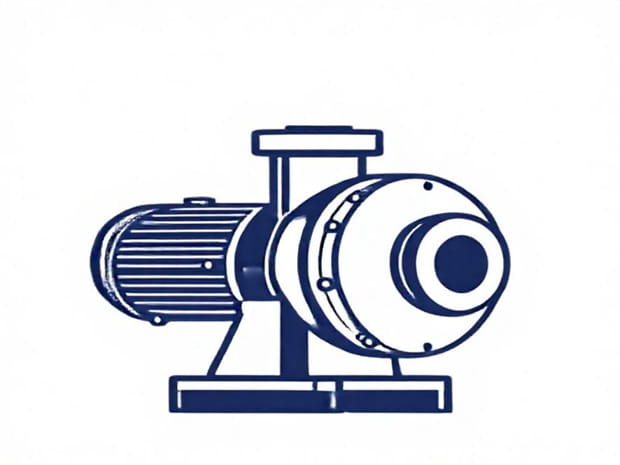
End Suction Centrifugal Pump
An end suction centrifugal pump is one of the most widely used types of pumps in industrial, commercial, and residential applications. It is known for its simple design, cost-effectiveness, and ability to handle a wide range of liquids efficiently. The pump features a suction inlet located at one end and a discharge outlet at the top, making it compact and easy to install in different systems. Its versatility has made it popular in water supply, HVAC systems, fire protection, and various industrial processes. Understanding how an end suction centrifugal pump works, its advantages, limitations, and applications helps engineers, operators, and businesses make informed decisions when selecting the right pumping solution.
Basic Design of an End Suction Centrifugal Pump
The end suction centrifugal pump has a straightforward design that contributes to its popularity. The suction nozzle is positioned at the front of the pump casing, and the discharge nozzle is located at the top. This configuration allows liquid to enter the impeller axially and be discharged radially through the volute casing.
The impeller is mounted on a shaft connected to a motor or engine, which provides the rotational energy. As the impeller spins, it imparts kinetic energy to the liquid, which is then converted into pressure energy in the volute casing. This design makes it effective in transporting liquids at different flow rates and pressures.
Working Principle
The working principle of an end suction centrifugal pump is based on the conversion of rotational energy into fluid energy. The process can be explained as follows
- Liquid enters the pump through the suction inlet.
- The impeller rotates, accelerating the liquid outward due to centrifugal force.
- The volute casing collects and directs the fluid to the discharge nozzle.
- The pressure increases as the velocity energy of the fluid is converted into pressure energy.
This mechanism makes end suction centrifugal pumps suitable for moving large volumes of fluid efficiently.
Key Components
The major components of an end suction centrifugal pump include
- Impeller– the rotating part that imparts energy to the liquid.
- Casing– the housing that directs and contains the liquid under pressure.
- Shaft– connects the impeller to the motor and transmits rotational energy.
- Bearings– support the shaft and reduce friction during rotation.
- Mechanical seal or packing– prevents leakage along the shaft.
- Motor– provides the power to drive the pump.
Advantages of End Suction Centrifugal Pumps
There are several reasons why end suction centrifugal pumps are widely chosen in different industries
- Compact design that requires less installation space.
- Cost-effective compared to other pump types.
- Easy to install, operate, and maintain.
- Versatile, capable of handling various liquids such as water, chemicals, and light slurries.
- Available in a wide range of materials to suit different applications.
- Efficient for high flow rate applications.
Limitations of End Suction Centrifugal Pumps
Despite their benefits, these pumps also have some disadvantages
- Not suitable for very high pressure applications compared to multistage pumps.
- Performance can drop if the liquid contains heavy solids or abrasive ptopics.
- Cavitation may occur if suction conditions are not properly maintained.
- Efficiency is lower when pumping very viscous fluids.
Understanding these limitations helps in choosing the correct pump for specific applications.
Applications of End Suction Centrifugal Pumps
The versatility of this pump type allows it to be used across many fields, including
- Water supply systems– municipal water distribution and irrigation.
- HVAC systems– circulating water in heating and cooling systems.
- Industrial processes– chemical processing, food and beverage industries, and pharmaceuticals.
- Fire protection systems– reliable pumping for fire hydrants and sprinkler systems.
- Marine applications– bilge pumping, cooling, and ballast operations.
Materials of Construction
The choice of material for an end suction centrifugal pump depends on the liquid being handled. Common materials include
- Cast iron – economical and widely used for water applications.
- Stainless steel – resistant to corrosion, suitable for chemicals and food industries.
- Bronze – used in marine environments due to saltwater resistance.
- Special alloys – for highly corrosive or abrasive fluids.
Maintenance Considerations
Regular maintenance ensures that an end suction centrifugal pump performs reliably and efficiently. Key maintenance practices include
- Checking and replacing seals to prevent leakage.
- Lubricating bearings to avoid friction and wear.
- Inspecting impellers for erosion, corrosion, or clogging.
- Monitoring vibration and noise levels to detect early signs of issues.
- Ensuring proper alignment between the pump and motor.
Proactive maintenance reduces downtime and extends the life of the pump.
Comparison with Other Pump Types
End suction centrifugal pumps are often compared with other pumps such as inline pumps, vertical turbine pumps, and multistage pumps. Some differences include
- Inline pumps– compact and used for space-limited applications, but less accessible for maintenance.
- Vertical turbine pumps– ideal for deep well applications, but require more complex installation.
- Multistage pumps– provide higher pressure but are more expensive and complex.
This shows that while end suction centrifugal pumps are versatile, they are not always the best choice for every application.
Energy Efficiency
Energy efficiency is an important factor in pump selection. End suction centrifugal pumps are designed for high efficiency at specific operating points. However, efficiency can decrease if the pump operates far from its best efficiency point (BEP). Proper sizing, selection, and control strategies such as variable frequency drives (VFDs) can improve energy use and reduce operating costs.
Installation Requirements
Proper installation of an end suction centrifugal pump is essential for reliable operation. Some key considerations include
- Ensuring correct alignment between the pump and motor.
- Providing a stable foundation to minimize vibration.
- Installing suction piping with minimal bends to reduce cavitation risk.
- Allowing adequate space around the pump for maintenance access.
Following installation best practices helps achieve optimal performance and longevity.
Future Developments
Advancements in technology continue to improve end suction centrifugal pumps. New materials are being developed for better corrosion resistance, while digital monitoring systems enable predictive maintenance. Energy-efficient designs and integration with smart control systems are also helping industries reduce operational costs and environmental impact.
The end suction centrifugal pump is a reliable and versatile piece of equipment that has earned its place in countless industries. Its simple yet effective design allows it to handle a variety of fluids, from water in municipal systems to chemicals in industrial processes. Although it has limitations in terms of pressure and handling abrasive or viscous fluids, its advantages in cost, ease of use, and efficiency make it a popular choice worldwide. With proper selection, installation, and maintenance, an end suction centrifugal pump can provide years of dependable service while meeting the demands of modern applications.