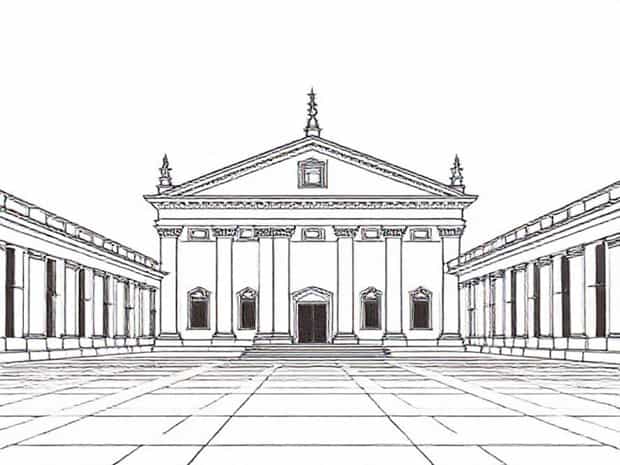
Filippo Brunelleschi Linear Perspective
Filippo Brunelleschi is widely celebrated as a pioneering figure in the history of art and architecture, particularly for his groundbreaking development of linear perspective during the Italian Renaissance. Linear perspective revolutionized the way artists represented three-dimensional space on a two-dimensional surface, creating a sense of depth and realism previously unattainable. Brunelleschi’s experiments with geometry and optical principles not only transformed painting but also influenced architecture, sculpture, and the visual arts for generations. Understanding Brunelleschi’s contribution to linear perspective offers insight into the foundations of modern artistic representation and the intellectual currents of the Renaissance.
The Historical Context of Linear Perspective
Before Brunelleschi’s innovations, artists often depicted space intuitively, resulting in inconsistent or distorted representations of depth. Medieval and early Renaissance paintings typically relied on overlapping figures, size hierarchies, and atmospheric cues rather than precise mathematical rules. The Renaissance, however, brought renewed interest in classical antiquity, mathematics, and scientific observation. Artists and architects sought methods to depict the visual world with accuracy, reflecting the period’s fascination with proportion, symmetry, and harmony. Brunelleschi’s discovery of linear perspective provided a systematic approach that bridged artistic practice and mathematical theory.
Brunelleschi’s Experiments
Brunelleschi, an architect and engineer, conducted a series of experiments in the early 15th century to test the principles of linear perspective. One famous demonstration involved creating a painted representation of the Florence Baptistery that could be viewed through a small hole using a mirror to see the reflection. This experiment illustrated how parallel lines converge at a single vanishing point on the horizon, a concept that became the cornerstone of linear perspective. By applying geometry to visual perception, Brunelleschi proved that spatial depth could be rendered convincingly on a flat surface.
Principles of Linear Perspective
Linear perspective relies on several fundamental principles that allow artists to depict depth accurately. One key element is the horizon line, representing the viewer’s eye level. Another is the vanishing point, where parallel lines appear to converge in the distance. Orthogonal lines, or lines that recede into space, guide the viewer’s eye toward the vanishing point. Using these principles, artists can create a sense of scale, distance, and proportion that mirrors human visual experience. Brunelleschi’s innovation lay in formalizing these principles into a repeatable method.
Components of Linear Perspective
- Horizon LineRepresents eye level and establishes spatial orientation.
- Vanishing PointThe point at which parallel lines converge in the distance.
- Orthogonal LinesLines that recede toward the vanishing point to create depth.
- Transversal LinesLines perpendicular to orthogonals that help measure proportional distances.
- Scale and ProportionObjects diminish in size relative to distance from the viewer.
Applications in Art
After demonstrating the concept of linear perspective, Brunelleschi’s methods were quickly adopted by painters throughout Florence and beyond. Masaccio, for example, incorporated perspective in his frescoes in the Brancacci Chapel, creating a convincing illusion of three-dimensional space. Artists could now design interiors, architectural elements, and landscapes with mathematical precision, enhancing realism and visual coherence. Linear perspective also allowed for more complex compositions, giving depth to narrative scenes and guiding the viewer’s attention strategically.
Impact on Renaissance Painting
- Enabled accurate representation of architectural spaces in artworks.
- Enhanced the realism of human figures in proportion to their surroundings.
- Created a sense of spatial depth in landscapes and cityscapes.
- Provided a systematic method for planning compositions and scenes.
- Influenced artists like Leonardo da Vinci, Piero della Francesca, and Botticelli.
Influence on Architecture
Brunelleschi’s work in linear perspective was closely linked to his architectural achievements. His designs, including the famous dome of the Florence Cathedral, demonstrate an understanding of spatial geometry and structural proportion that parallels his studies in perspective. Architects could now conceptualize complex structures with precise spatial relationships, facilitating more ambitious and harmonious designs. The principles of perspective also guided urban planning and the representation of architectural projects in drawings, allowing clients and patrons to visualize completed structures.
Key Architectural Implications
- Enhanced planning and visualization of complex architectural projects.
- Improved proportional accuracy in building design and interior spaces.
- Integration of visual aesthetics with structural engineering principles.
- Influenced the design of public squares, streets, and interior layouts.
- Provided a foundation for architectural drawing conventions still used today.
Mathematical Foundations
Brunelleschi’s approach to linear perspective was not purely artistic; it was grounded in geometry and optics. By observing how parallel lines converge in human vision, he applied mathematical principles to create realistic spatial illusions. This intersection of art and mathematics reflects the Renaissance ideal of harmonizing empirical observation with intellectual inquiry. Artists and architects could now quantify spatial relationships, calculate proportions accurately, and reproduce scenes consistently from different viewpoints.
Legacy of Mathematical Perspective
- Introduced the use of geometry in visual representation of space.
- Influenced subsequent developments in projective geometry and technical drawing.
- Enabled artists to experiment with complex visual compositions systematically.
- Laid the groundwork for modern understanding of perspective in visual media.
- Bridged the gap between art, science, and engineering during the Renaissance.
Filippo Brunelleschi’s invention of linear perspective marked a turning point in the history of art and architecture, transforming the way space and depth were represented. By formalizing the principles of vanishing points, orthogonal lines, and proportional scale, he enabled artists and architects to create realistic, mathematically precise depictions of the world. His influence extended beyond painting to architecture, urban planning, and the study of optics, shaping Renaissance art and continuing to inform visual practices today. Understanding Brunelleschi’s linear perspective provides valuable insight into the intellectual, artistic, and cultural achievements of the Renaissance, highlighting the enduring impact of one of history’s greatest innovators.