Give The Merits Of Mendeleev Periodic Table
The development of the periodic table was one of the greatest achievements in chemistry, and Dmitri Ivanovich Mendeleev is remembered as the scientist who made it possible. His periodic table was not just an arrangement of known elements but also a scientific tool that predicted the discovery of new ones. Mendeleev’s work was groundbreaking because it provided order to the chemical world, explained recurring trends in properties, and offered a foundation for future research. The merits of Mendeleev’s periodic table highlight its scientific value, practical usefulness, and its role in shaping modern chemistry.
Historical Context of Mendeleev’s Periodic Table
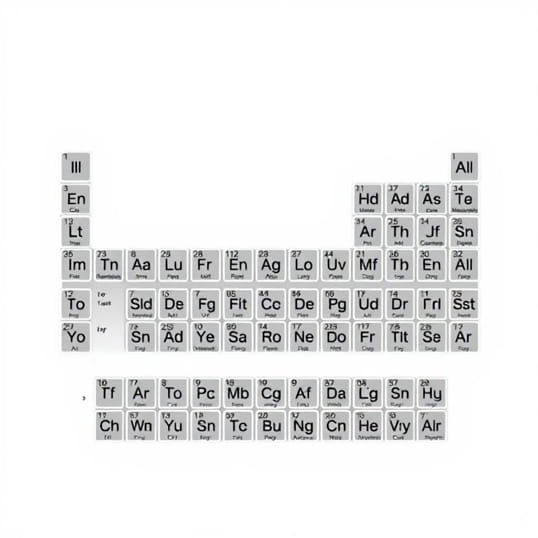
During the mid-19th century, many elements had already been discovered, but there was no systematic way to organize them. Scientists attempted several classifications, such as arranging elements by atomic mass or grouping them by similarities in properties. However, these systems were incomplete and inconsistent. In 1869, Mendeleev proposed his periodic table, arranging elements by increasing atomic mass while grouping those with similar chemical properties together. This arrangement revealed periodic trends, which meant that properties of elements repeated at regular intervals.
Main Merits of Mendeleev’s Periodic Table
Mendeleev’s periodic table offered several advantages compared to earlier attempts. These merits demonstrated his scientific insight and helped establish the periodic law as a central principle of chemistry.
1. Systematic Organization of Elements
One of the greatest merits of Mendeleev’s periodic table was that it provided a logical structure for arranging elements. Instead of random lists or isolated groups, his table placed elements with similar properties in the same columns, which made patterns clear and easy to study. This organization helped scientists compare elements effectively and predict how they would behave in chemical reactions.
2. Prediction of Undiscovered Elements
Perhaps the most remarkable feature of Mendeleev’s work was his bold decision to leave gaps in his periodic table. He believed these gaps represented undiscovered elements and even predicted their properties with surprising accuracy. For example, he predicted the existence of elements such as gallium, scandium, and germanium, describing their approximate atomic masses, densities, and chemical behavior. When these elements were later discovered, their properties closely matched his predictions, proving the validity of his table.
3. Correction of Atomic Masses
Mendeleev’s table also helped identify errors in the known atomic masses of certain elements. By studying their properties and positions in the periodic table, he corrected the values of several elements, including beryllium and uranium. This was a major merit because it improved the accuracy of chemical data and guided future experimental research.
4. Demonstration of Periodic Law
Mendeleev’s periodic law stated that the properties of elements are a periodic function of their atomic masses. This meant that elements with similar properties appeared at regular intervals when arranged in order of increasing atomic mass. His formulation of the periodic law provided a strong scientific principle that helped explain trends in chemical and physical behavior, making chemistry more predictable and systematic.
5. Clear Grouping of Elements
The grouping of elements in Mendeleev’s table was another important merit. For the first time, elements were arranged in families or groups that shared similar valency and chemical properties. For example, alkali metals were placed together, halogens formed another group, and noble metals were also classified properly. This made the study of chemistry easier for scientists and students alike.
6. Foundation for Modern Periodic Table
Although the modern periodic table is arranged by atomic number instead of atomic mass, it still owes its foundation to Mendeleev’s work. His table established the framework that guided later scientists, such as Moseley, who refined the periodic law. Without Mendeleev’s vision, the modern classification of elements might not have developed so effectively.
Additional Merits of Mendeleev’s Periodic Table
Beyond the major contributions, Mendeleev’s table also had several additional merits that showed his deep understanding of chemistry
- Flexibility in arrangementMendeleev was willing to adjust the position of elements when their chemical properties did not match the order of atomic mass. For instance, he placed iodine after tellurium despite its lower atomic mass because it fit better with the halogens.
- Educational toolThe table made it easier to teach and learn chemistry by providing a clear and logical classification of elements.
- Encouragement of discoveryBy predicting new elements, Mendeleev inspired chemists to search for them, driving scientific progress.
- Unification of knowledgeHis table brought together chemical, physical, and atomic data into one system, making it easier to study relationships between elements.
Scientific Impact of the Merits
The merits of Mendeleev’s periodic table had a lasting impact on the scientific community. His predictions validated the periodic law, making chemistry a more exact science. Researchers gained confidence in the table as a reliable tool for experimentation and discovery. The corrections in atomic masses improved chemical accuracy, while the grouping of elements provided insight into bonding, reactivity, and periodic trends.
Comparison with Previous Classifications
Before Mendeleev, other scientists had attempted classifications such as Dobereiner’s triads and Newlands’ law of octaves. While these efforts recognized some recurring patterns, they lacked the depth and predictive power of Mendeleev’s table. The merit of his work lay in going beyond surface-level similarities to establish a comprehensive system supported by strong evidence.
Limitations and How They Were Resolved
Although the Mendeleev periodic table was highly successful, it was not without limitations. For example, placing elements strictly by atomic mass caused inconsistencies in some cases. These were later resolved when Henry Moseley introduced the concept of atomic number as the basis for arrangement. Despite these shortcomings, the merits of Mendeleev’s system far outweighed its limitations, as it provided a critical step toward the modern periodic table.
Applications of Mendeleev’s Table in Modern Chemistry
Even today, the merits of Mendeleev’s periodic table are evident in modern applications
- Used as the foundation for teaching periodic trends in schools and universities.
- Guides research in inorganic chemistry, where trends in reactivity and bonding are studied.
- Supports materials science, where the properties of new alloys and compounds are predicted using periodic trends.
- Provides a reference point for the development of synthetic elements, continuing the tradition of prediction.
The merits of Mendeleev’s periodic table lie in its ability to organize elements logically, predict new ones, correct atomic masses, and establish the periodic law. It grouped elements in a way that reflected their true chemical nature, transforming chemistry into a more systematic and predictive science. While later refinements improved its accuracy, the fundamental ideas introduced by Mendeleev remain central to the modern periodic table. His vision not only solved the problem of classification but also inspired generations of scientists to explore the periodicity of elements, making his table one of the most influential tools in the history of science.