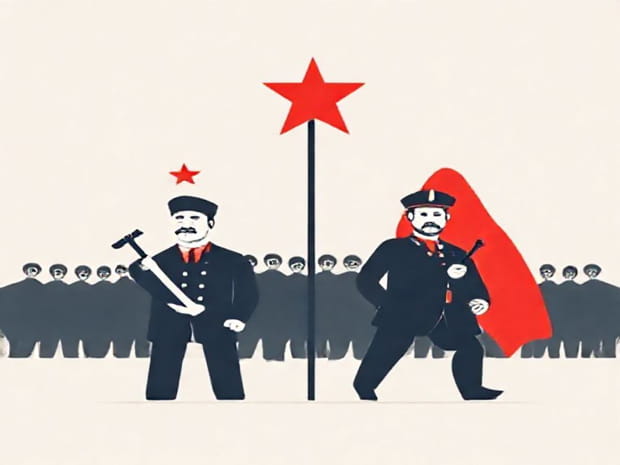
Difference Between Communism And Dictatorship
In the study of political systems, understanding the difference between communism and dictatorship is essential for grasping how societies are structured and governed. Both terms are often misunderstood or used interchangeably in everyday conversation, yet they represent fundamentally different concepts. Communism is primarily an economic and social ideology focused on the collective ownership of resources and the elimination of class distinctions, while dictatorship refers to a form of political power where authority is centralized in a single leader or ruling group. Exploring these two concepts in detail can help clarify the distinctions and overlaps that exist between them, providing insight into historical examples, governance structures, and the impact on citizens’ daily lives.
Defining Communism
Communism is a political and economic ideology that advocates for a classless society in which all property and resources are collectively owned. The central idea of communism is that wealth and production should be shared equally among all members of society, eliminating the disparities created by capitalism. Communism is rooted in the works of Karl Marx and Friedrich Engels, who envisioned a world where the means of production such as factories, land, and natural resources are controlled by the community rather than private individuals.
Key Principles of Communism
- Collective OwnershipAll means of production are owned and controlled collectively, aiming to eliminate private wealth accumulation.
- Classless SocietySocial distinctions based on wealth and status are abolished, creating equality among citizens.
- Central PlanningEconomic decisions are often planned by the state to ensure equitable distribution of goods and services.
- Focus on EqualityThe system emphasizes equal opportunities and access to resources for all individuals.
In practice, communist countries often implement these principles through government control of major industries, regulation of production and distribution, and policies designed to reduce economic inequalities. However, not all societies labeled as communist achieve true classless equality, leading to debates about the effectiveness and implementation of the ideology.
Defining Dictatorship
Dictatorship is a form of governance where power is concentrated in the hands of a single ruler or a small group, often without the consent or participation of the broader population. Unlike communism, which is an economic and social philosophy, dictatorship is purely a political structure. Dictators often maintain control through authoritarian measures, restricting civil liberties, controlling the media, and suppressing opposition to secure their rule. While a dictatorship can exist in various political and economic systems, including democracies and monarchies, its defining feature is the absolute concentration of power.
Key Characteristics of a Dictatorship
- Centralized PowerPolitical authority is held by one person or a small group, often bypassing democratic institutions.
- Limited Civil LibertiesFreedom of speech, press, and assembly are often restricted to maintain control.
- Suppression of OppositionPolitical opponents are silenced through intimidation, imprisonment, or violence.
- Control over InstitutionsGovernment, military, and law enforcement are typically under direct control of the dictator.
Dictatorships can emerge from political instability, economic crises, or social unrest, where citizens may accept concentrated power in exchange for perceived security or order. Historical examples include totalitarian regimes in the 20th century, where leaders wielded unchecked power over every aspect of public and private life.
Comparing Communism and Dictatorship
While communism and dictatorship are distinct concepts, they can intersect in certain political contexts. Some countries that adopt communism may develop dictatorial leadership structures, leading to a blend of both systems. Understanding the differences and similarities helps in analyzing global political landscapes and avoiding common misconceptions.
Differences
- NatureCommunism is an ideology focused on economics and social structure, whereas dictatorship is a form of political authority.
- GoalCommunism seeks a classless, equitable society. Dictatorship seeks centralized control, often for the benefit of the ruler or ruling group.
- ImplementationCommunism can theoretically exist without dictatorship, using democratic planning and collective governance. Dictatorship can exist in capitalist, communist, or mixed economies.
- Power DistributionCommunism promotes shared ownership of resources; dictatorship consolidates power in one individual or group.
Similarities
- State ControlBoth systems may involve significant government control over the economy and society.
- Potential for AuthoritarianismSome communist states have historically adopted dictatorial governance to enforce policies.
- Impact on CitizensIn both systems, individuals may face restrictions on personal freedoms and political participation depending on the leadership style.
Historical Context
Throughout history, the line between communism and dictatorship has often blurred. The Soviet Union is a prominent example of a communist state that developed a dictatorial system under leaders such as Joseph Stalin. While the ideology promoted collective ownership and equality, the political reality involved intense centralization of power, suppression of dissent, and limited individual freedoms. Similarly, other countries like China, North Korea, and Cuba have combined communist principles with strong, centralized political control, illustrating the practical challenges of implementing pure communism without authoritarian measures.
Modern Implications
Today, understanding the difference between communism and dictatorship is crucial for analyzing international relations, economic policies, and human rights issues. Scholars and policymakers often examine whether governments labeled as communist genuinely pursue collective equality or whether dictatorial elements undermine the ideological goals. Recognizing the distinctions also helps citizens critically evaluate the promises of political movements and the risks of concentrated power.
communism and dictatorship are two separate but occasionally overlapping concepts in political science. Communism is an ideology centered on economic equality and the elimination of class divisions, while dictatorship is a political structure characterized by centralized power and limited freedoms. The historical and contemporary examples show that while a communist state can develop dictatorial features, not all dictatorships are communist, and not all communist systems are inherently dictatorial. Understanding these differences provides a clearer lens through which to view political systems, helping individuals make informed judgments about governance, ideology, and the balance of power in society.